Acrylic Hotel Door Signs Customization Guide for Hotels
Acrylic hotel door signs customization guide: digital printing, braille integration, color matching, and ADA compliance for hotel procurement teams.
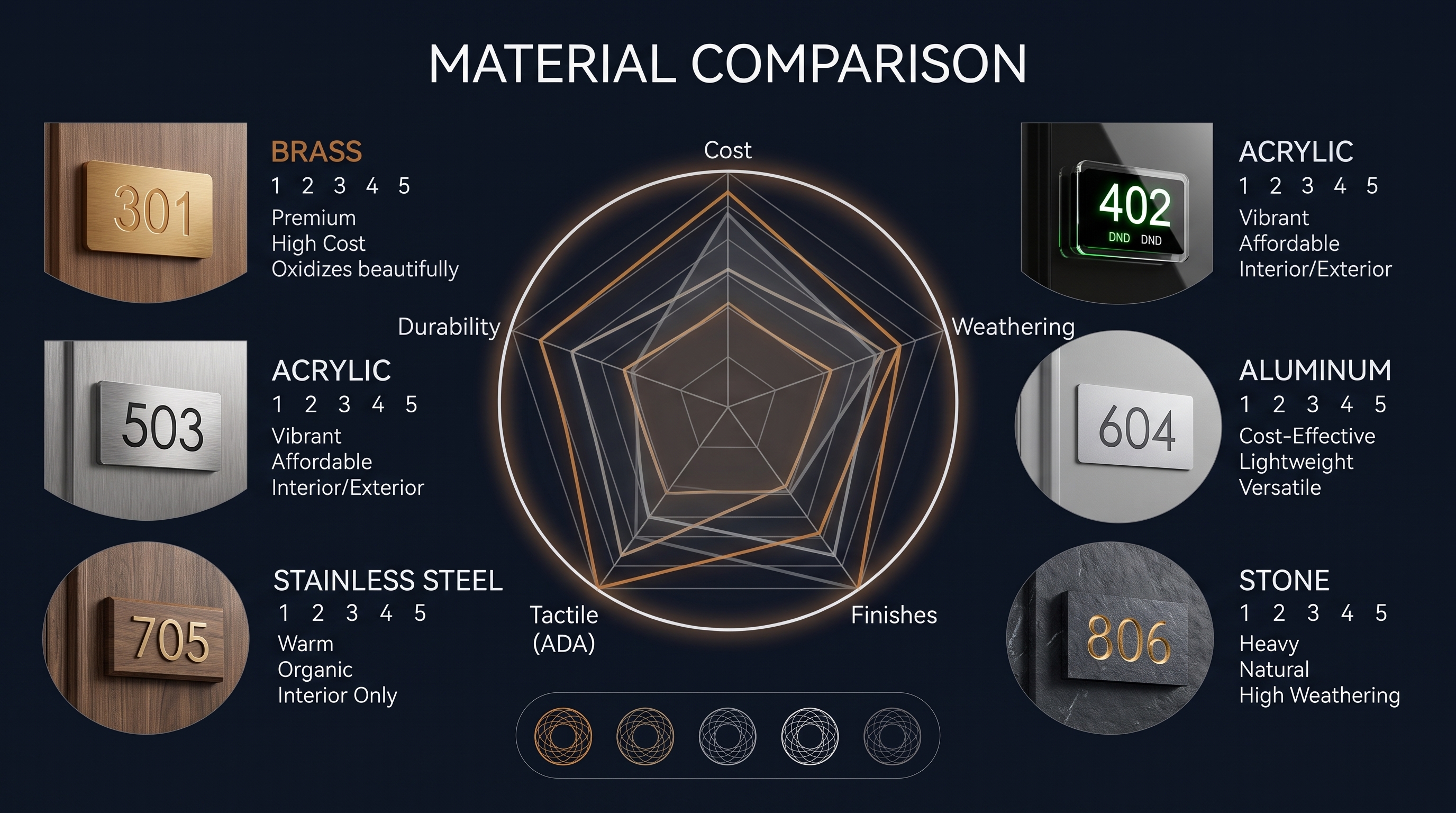
Acrylic hotel door signs customization guide is the most critical specification resource a hotel procurement team uses when specifying a cost-effective, visually flexible, and ADA-compliant door identification system. Acrylic signs deliver a premium visual presentation at a fraction of the cost of brass, stainless steel, and other metal alternatives, and the acrylic hotel door signs customization guide must balance the visual impact, the ADA compliance, the material durability, and the per-room cost to arrive at a specification that meets brand standards and budget targets. The acrylic hotel door signs customization guide provides a structured decision matrix that procurement teams can use to specify the optimal customization options for material grade, finish, digital printing capability, braille integration, color matching, and ADA compliance.
Acrylic hotel door signs are the most cost-effective solution for midscale, upper-midscale, and upscale hotel properties that require a premium visual presentation at a moderate per-room unit cost. The material offers significant cost savings over brass, stainless steel, and other metal options, with a per-room cost that is typically 60 to 80 percent lower than premium metal signs for the standard thickness with the standard finish. The acrylic hotel door signs cost advantage is particularly significant for properties with more than 100 rooms, where the per-room savings accumulate across the entire property to deliver a measurable reduction in the total project capex.
The acrylic hotel door signs customization capability is the material’s strongest asset, and the customization options allow the procurement team to achieve branding-led presentation that aligns with the property interior design. The digital printing technology that is available for acrylic door signs allows the supplier to apply high-resolution brand logos, typography, and images that would be prohibitively expensive to achieve in metal materials. The braille integration is also more straightforward for acrylic signs, because the supplier can apply the braille to the acrylic surface with a consistent quality and at a lower labor cost than the braille integration in metal materials. The acrylic material also supports a wider range of color matching options, because the supplier can match the acrylic color to the interior color palette and can apply custom colors that are not feasible in metal materials.
Why Acrylic Hotel Door Signs Customization Justifies the Specification
Acrylic hotel door signs customization justifies the specification because the material delivers a combination of visual flexibility, brand alignment, ADA compliance, and cost-effectiveness that metal materials cannot replicate at the same price point. The upfront cost advantage of acrylic over metal is substantial, but the customization guide also reveals that acrylic delivers value through the broader range of ADA-compliant options, the broader range of color matching capabilities, and the broader range of digital printing options. The customization guide must therefore be framed as a total value comparison that includes the per-room cost, the visual presentation, the ADA compliance scope, and the long-term maintenance rather than a per-room cost comparison alone.
The acrylic hotel door signs customization guide is a critical input to the brand standard governance process that chain procurement teams operate, because the customization scope is the primary lever that procurement teams use to align the door signs with the property interior design. The chain procurement team that specifies the customization scope must account for the digital printing templates that will be applied to the standard room signs, the suite identification, the suite door signs, the elevator lobby signs, and the amenity signs throughout the property. The customization guide recommends that procurement teams align the customization scope with the brand book to ensure that the door signs deliver the expected brand presentation across all guest touchpoints.
The acrylic hotel door signs customization guide also extends to the property financial planning and the capex budget allocation, because the customization scope can add 10 to 50 percent to the per-room unit cost depending on the digital printing complexity, the braille integration scope, and the color matching scope. The procurement team that understands the cost impact of the customization options is better positioned to defend the specification against cost-reduction pressure from the property finance team. The customization guide must therefore include a structured decision matrix that quantifies the cost impact of the customization options and that presents the value proposition in terms that support financial justification.
Acrylic Hotel Door Signs Material Grade Options
Acrylic hotel door signs material grade options define the primary cost and performance dimensions of the customization guide, and the material grade selection drives the per-room cost more than any other specification axis. The customization guide typically presents three material grade tiers that align with the property brand tier and the interior design phase. The first tier is the standard acrylic grade, which is the baseline specification for most midscale and upper-midscale projects. The second tier is the premium acrylic grade, which is the specification for upscale properties and for areas with higher visibility such as the executive suites, the corridors, and the elevator lobbies. The third tier is the architectural acrylic grade, which is the specification for flagship properties and architecturally significant areas.
The standard acrylic grade for hotel door signs is typically extruded acrylic with a thickness of 3 to 6 millimeters, which is the industry standard for signage fabrication and installation. The extruded acrylic grade delivers adequate durability for indoor hotel corridors at a moderate cost, with a per-room unit cost that is typically $5 to $15 depending on the size, the finish, and the digital printing scope. The customization guide treats the extruded acrylic grade as the baseline and applies cost multipliers for the higher grades, the premium finishes, and the complex digital printing.
The premium acrylic grade for hotel door signs is typically cast acrylic with a thickness of 6 to 12 millimeters, which delivers superior impact resistance, superior optical clarity, and superior surface finish for the higher-end finishes. The premium grade carries a 30 to 60 percent cost premium over the extruded acrylic grade, with a per-room unit cost that is typically $10 to $30. The customization guide applies the premium grade specification to the executive suites, the high-visibility corridors, the amenity signs, and the areas where the guest perception of quality is most sensitive.
The architectural acrylic grade for hotel door signs is typically multi-layered or composite acrylic with a thickness of 12 to 25 millimeters, which delivers the highest durability, the most refined finish options, and the most complex digital printing for the most demanding applications. The architectural grade carries a 100 to 200 percent cost premium over the extruded acrylic grade, with a per-room unit cost that is typically $20 to $50 or higher for the most demanding applications. The customization guide applies the architectural grade specification sparingly, typically for the signature entrance signage, the flagship branding signage, and the most architecturally significant public areas.
Acrylic Hotel Door Signs Finish and Surface Treatment Options
Acrylic hotel door signs finish and surface treatment options define the visual presentation dimension of the customization guide, and the finish selection can add 10 to 50 percent to the base material cost. The customization guide typically presents four finish tiers that align with the interior design phase and the brand presentation standards. The first finish is the clear finish, which is the baseline for the extruded acrylic grade. The second finish is the matte finish, which provides a non-reflective surface that is well suited to contemporary interiors and to areas with higher ambient light. The third finish is the satin finish, which provides a subtle sheen that is well suited to neutral palettes and to midtones. The fourth finish is the textured or frosted finish, which provides a directional grain or a surface geometry that is well suited to architectural applications.
The clear finish is the most popular finish for acrylic hotel door signs, because the optical clarity delivers the most premium visual presentation that supports the brand positioning. The clear finish is typically priced at the baseline for the extruded acrylic grade, with no premium over the unfinished acrylic material. The customization guide treats the clear finish as the default specification for most acrylic door signs, with the matte, satin, and textured finishes priced as upgrades.
The matte finish provides a non-reflective surface that reduces the glare from the corridor lighting and that is well suited to contemporary interiors. The matte finish is typically priced at a 10 to 20 percent premium over the clear finish, which reflects the additional fabrication labor required to apply the consistent matte surface. The customization guide treats the matte finish as the recommended default for many upscale properties, particularly for properties with contemporary or minimalist interior design.
The satin finish provides a subtle sheen that adds visual interest while reducing the reflectivity from the corridor lighting. The satin finish is typically priced at a 20 to 40 percent premium over the clear finish, which reflects the additional labor required to apply the consistent satin sheen. The customization guide treats the satin finish as the recommended specification for neutral palettes and for midtones.
The textured or frosted finish provides a directional grain or a surface geometry that adds visual interest and that is well suited to architectural applications. The textured finish is typically priced at a 40 to 100 percent premium over the clear finish, which reflects the additional labor required to apply the custom surface geometry. The customization guide treats the textured finish as the recommended specification for flagship branding signage and for architectural applications.
Acrylic Hotel Door Signs Digital Printing Scope
Acrylic hotel door signs digital printing scope is the fourth major cost dimension of the customization guide, and the digital printing complexity can add 20 to 80 percent to the base material and finish cost. The customization guide typically distinguishes between standard digital printing, premium digital printing, and full brand integration. The standard digital printing is the typical specification for most properties, with the room number, the brand logo, and the interior design elements applied to the standard sign template. The premium digital printing is the specification for properties that require higher resolution typography, custom color matching, or complex brand integration. The full brand integration is the specification for flagship properties that require bespoke image integration.
The standard digital printing cost for acrylic hotel door signs is typically included in the base unit price for the extruded acrylic grade with the clear finish, because the digital printing is performed on a large-format printer with a standardized template. The standard digital printing cost adds 5 to 15 percent to the base material and finish cost for the premium and architectural grades, which reflects the additional setup time for the larger materials and the higher printing resolution.
The premium digital printing cost for acrylic hotel door signs is typically priced at a 20 to 50 percent premium over the standard printing, which reflects the additional design time, the additional setup time, and the higher printing resolution required to apply the premium typography or the premium brand integration. The customization guide treats the premium digital printing as the recommended specification for properties that require higher visual presentation, with the cost premium quantified and the design approval process integrated into the procurement timeline.
The full brand integration cost for acrylic hotel door signs is typically priced at a 50 to 100 percent premium over the standard printing, which reflects the bespoke design process, the bespoke printing setup, and the small-batch quality control required to deliver the brand-integrated product. The customization guide treats the full brand integration as the specification for flagship properties only, with the cost premium quantified and the quantity per property typically limited to a small number of pieces.
Acrylic Hotel Door Signs Braille and ADA Compliance Scope
Acrylic hotel door signs braille and ADA compliance scope is the fifth major cost dimension of the customization guide, and the braille integration can add 10 to 40 percent to the base material and finish cost. The customization guide typically distinguishes between standard braille integration, premium braille integration, and full ADA compliance. The standard braille integration is the typical specification for most properties, with the braille applied to the standard sign template at the braille points that are specified in the ADA standards. The premium braille integration is the specification for properties that require higher braille quality, custom braille placement, or complex braille placement. The full ADA compliance is the specification for flagship properties that require comprehensive ADA integration.
The standard braille integration cost for acrylic hotel door signs is typically included in the base unit price for the extruded acrylic grade with the standard printing, because the braille is applied to the acrylic surface with a standard process. The standard braille integration cost adds 5 to 15 percent to the base material and finish cost for the premium and architectural grades, which reflects the additional setup time for the larger materials.
The premium braille integration cost for acrylic hotel door signs is typically priced at a 10 to 30 percent premium over the standard braille, which reflects the additional design time and the additional fabrication labor required to achieve the premium braille quality or the premium braille placement. The customization guide treats the premium braille integration as the specification for upscale properties, with the cost premium quantified.
The full ADA compliance cost for acrylic hotel door signs is typically priced at a 30 to 100 percent premium over the standard specification, which reflects the comprehensive ADA integration that includes the full braille, the tactile text, the high-contrast color, and the ADA-compliant installation. The customization guide treats the full ADA compliance as the specification for flagship properties, with the cost premium quantified.
Acrylic Hotel Door Signs Color Matching Precision
Acrylic hotel door signs color matching precision is the sixth major cost dimension of the customization guide, and the color matching scope can add 10 to 50 percent to the base material and finish cost. The customization guide typically presents three color matching tiers that align with the interior design phase and the brand presentation standards. The first tier is the standard color match, which is the baseline specification for most midscale and upper-midscale projects. The second tier is the premium color match, which is the specification for upscale properties and for areas with higher visibility. The third tier is the architectural color match, which is the specification for flagship properties and architecturally significant areas.
The standard color match for acrylic hotel door signs is typically achieved with Pantone color alignment or RAL color alignment that aligns with the brand color palette. The standard color match carries a 5 to 15 percent cost premium over the base material cost, with a per-room unit cost that is typically $0.50 to $1.50 higher than the base material for the 3 to 6 millimeter thickness. The customization guide treats the standard color match as the baseline specification and applies cost multipliers for the premium and architectural color matching.
The premium color match for acrylic hotel door signs is typically achieved with custom color formulation that precisely matches the property interior color palette. The premium color match carries a 20 to 40 percent cost premium over the base material cost, with a per-room unit cost that is typically $1.50 to $3 higher than the base material. The customization guide applies the premium color match specification to the suite identification, the amenity signage, and the areas where the guest perception of color accuracy is most sensitive.
The architectural color match for acrylic hotel door signs is typically achieved with multi-layered or composite acrylic that delivers the exact color, the exact translucency, and the exact surface finish for the most demanding applications. The architectural color match carries a 50 to 100 percent cost premium over the base material cost, with a per-room unit cost that is typically $3 to $8 higher than the base material. The customization guide applies the architectural color match specification sparingly, typically for the signature entrance signage and the architecturally significant public areas where the exact color match is part of the broader architectural design intent.
Acrylic Hotel Door Signs Digital Printing and Maintenance Relationship
Acrylic hotel door signs digital printing and maintenance relationship is the seventh major cost dimension of the customization guide, and the digital printing scope can affect the maintenance cost over the 5 to 10 year service life. The customization guide typically distinguishes between standard printing, premium printing, and full brand integration based on the maintenance scope and the expected exposure to environmental factors. The standard printing typically requires minimal maintenance, with the digital print protected by the surface finish and the installation environment. The premium printing typically requires moderate maintenance, with the digital print exposed to higher environmental factors that can affect the print longevity. The full brand integration typically requires the highest maintenance, with the complex image integration exposed to the highest environmental factors.
The standard digital printing for acrylic hotel door signs typically has a 5 to 10 year expected lifespan in indoor hotel corridors, with the digital print protected by the surface finish and the indoor environment. The maintenance cost for the standard printing is typically $0.50 to $1 per room per year, which covers the routine cleaning and the minor touch-up that the print may require. The customization guide treats the standard printing as the baseline specification and applies cost multipliers for the premium printing and the full brand integration.
The premium digital printing for acrylic hotel door signs typically has a 3 to 7 year expected lifespan in indoor hotel corridors, with the digital print exposed to higher environmental factors such as the direct corridor lighting, the higher humidity, or the higher cleaning chemical exposure. The maintenance cost for the premium printing is typically $1 to $2 per room per year, which covers the routine cleaning, the minor touch-up, and the potential print replacement that the print may require. The customization guide applies the premium printing specification to the areas with higher visibility and the areas with higher exposure to environmental factors.
The full brand integration for acrylic hotel door signs typically has a 2 to 5 year expected lifespan in indoor hotel corridors, with the complex image integration exposed to the highest environmental factors. The maintenance cost for the full brand integration is typically $2 to $4 per room per year, which covers the routine cleaning, the minor touch-up, the complex image integration maintenance, and the potential print replacement. The customization guide applies the full brand integration specification to the flagship branding signage and the architecturally significant areas.
Acrylic Hotel Door Signs Supplier Qualification Criteria
Acrylic hotel door signs supplier qualification criteria is the eighth major cost dimension of the customization guide, and the supplier qualification can affect the total project cost through the defect rate, the installation support, and the after-sales service scope. The customization guide typically presents a supplier qualification checklist that procurement teams can use to evaluate suppliers, to validate proposals, and to negotiate the best total value. The first checklist item is the manufacturer certification, which captures the material supplier certifications, the fabrication process certifications, and the quality management system certifications. The second checklist item is the hospitality experience, which captures the supplier experience with hotel properties, the references from comparable properties, and the hotel brand standard alignment. The third checklist item is the digital printing capability, which captures the printing equipment, the printing resolution, the color matching capability, and the printing technology. The fourth checklist item is the braille integration capability, which captures the braille integration equipment, the braille integration process, and the ADA compliance certification. The fifth checklist item is the customization scope, which captures the design capability, the fabrication capacity, and the small-batch quality control.
The sixth checklist item is the delivery timeline, which captures the supplier production capacity, the delivery commitment, the installation support, and the emergency response. The seventh checklist item is the after-sales service scope, which captures the defect replacement commitment, the warranty coverage, the spare parts availability, and the maintenance support. The eighth checklist item is the cost structure, which captures the unit price, the volume discount, the installation support cost, and the maintenance support cost. The ninth checklist item is the brand alignment, which captures the supplier commitment to the hotel brand standards, the brand book conformance, and the brand governance alignment.
Supplier qualification criteria that procurement teams use to evaluate suppliers typically deliver a 10 to 25 percent reduction in total project cost compared to procurement teams that evaluate on unit price alone, because the supplier qualification criteria expose the defect rate, the maintenance cost, and the after-sales service scope that affect the long-term cost but not the initial quote. The customization guide is therefore as much a procurement resource as it is a specification resource.
Acrylic Hotel Door Signs Installation and Fastener Options
Acrylic hotel door signs installation and fastener options is the ninth major cost dimension of the customization guide, and the installation and fastener scope can affect the per-room installation cost and the long-term durability. The customization guide typically presents three installation tiers that align with the property renovation phase and the installation labor availability. The first tier is the standard installation, which is the baseline specification for most properties. The second tier is the premium installation, which is the specification for properties that require higher installation quality. The third tier is the architectural installation, which is the specification for flagship properties and architecturally significant areas.
The standard installation for acrylic hotel door signs typically uses adhesive mounting or small fasteners that are appropriate for the 3 to 6 millimeter thickness of the standard material grade. The standard installation cost is typically $2 to $5 per room, with the installation labor typically sourced from the local subcontractor network. The customization guide treats the standard installation as the baseline and applies cost multipliers for the premium and architectural installation.
The premium installation for acrylic hotel door signs typically uses larger fasteners or mechanical mounting hardware that is appropriate for the 6 to 12 millimeter thickness of the premium material grade. The premium installation cost is typically $5 to $12 per room, with the installation labor typically sourced from the specialized signage installation contractor. The customization guide applies the premium installation specification to the executive suites, the high-visibility corridors, and the amenity signage.
The architectural installation for acrylic hotel door signs typically uses custom mounting hardware or custom mounting systems that are appropriate for the 12 to 25 millimeter thickness of the architectural material grade. The architectural installation cost is typically $12 to $25 per room, with the installation labor typically sourced from the specialized signage installation contractor or the architectural metal contractor. The customization guide applies the architectural installation specification sparingly, typically for the signature entrance signage and the architecturally significant public areas.
Acrylic Hotel Door Signs Procurement Checklist
A complete acrylic hotel door signs procurement checklist consolidates the previous sections into a decision matrix that procurement teams can use to brief vendors, validate proposals, and negotiate the best total value. The first checklist item is material grade, which captures the extruded, cast, or multi-layered acrylic grade. The second checklist item is finish specification, which captures the clear, matte, satin, or textured finish. The third checklist item is digital printing scope, which captures the standard, premium, or full brand integration. The fourth checklist item is braille integration, which captures the standard, premium, or full ADA compliance. The fifth checklist item is color matching, which captures the standard, premium, or architectural color match. The sixth checklist item is installation scope, which captures the standard, premium, or architectural installation tier. The seventh checklist item is supplier qualification, which captures the manufacturer certifications, the hospitality experience, the digital printing capability, the braille integration capability, and the customization scope. The eighth checklist item is after-sales service, which captures the defect replacement commitment, the warranty coverage, the spare parts availability, and the maintenance support. The ninth checklist item is brand alignment, which captures the supplier commitment to the brand standards and the brand book conformance.
The tenth checklist item is total cost of ownership, which captures the unit price, the installation labor, the maintenance labor, the braille replacement cost, the replacement frequency, and the end-of-life disposal cost. The eleventh checklist item is sustainability, which captures the recycled content of the acrylic material, the end-of-life recyclability, and the supplier environmental management system. The twelfth checklist item is brand presentation, which captures the visual presentation alignment with the interior design, the brand book conformance, and the guest perception of quality. The procurement team that walks through this acrylic hotel door signs procurement checklist before issuing a vendor RFQ typically achieves a 15 to 25 percent reduction in total project cost compared to teams that select on unit price alone.
Acrylic Hotel Door Signs Brand Presentation and Visual Impact
Acrylic hotel door signs brand presentation and visual impact is the third major cost dimension of the customization guide, and the brand presentation scope can add 10 to 40 percent to the base material and finish cost. The customization guide typically presents a brand presentation matrix that procurement teams can use to align the door signs with the property interior design and the brand book standards. The first matrix dimension is the visual presentation, which captures the typography, the brand logo, the color palette, and the surface treatment. The second matrix dimension is the brand alignment, which captures the brand book conformance, the brand standard governance, and the brand evolution alignment. The third matrix dimension is the guest perception, which captures the visual impact at the moment of room approach, the perceived property quality, and the brand impression.
The standard brand presentation for acrylic hotel door signs typically aligns with the brand book typography and color palette, with the standard digital printing scope applied to the standard sign template. The standard brand presentation carries a 5 to 15 percent cost premium over the base material cost, with a per-room unit cost that is typically $0.50 to $2 higher than the base material. The customization guide treats the standard brand presentation as the baseline specification and applies cost multipliers for the premium and architectural brand presentation.
The premium brand presentation for acrylic hotel door signs typically aligns with the brand book typography and color palette, with the premium digital printing scope and the premium color matching scope applied to the premium sign template. The premium brand presentation carries a 20 to 40 percent cost premium over the base material cost, with a per-room unit cost that is typically $2 to $5 higher than the base material. The customization guide applies the premium brand presentation specification to the suite identification, the amenity signage, and the areas where the brand presentation is most sensitive.
The architectural brand presentation for acrylic hotel door signs typically aligns with the brand book typography and color palette, with the full brand integration and the architectural color matching scope applied to the architectural sign template. The architectural brand presentation carries a 40 to 80 percent cost premium over the base material cost, with a per-room unit cost that is typically $5 to $15 higher than the base material. The customization guide applies the architectural brand presentation specification sparingly, typically for the signature entrance signage and the architecturally significant public areas where the brand presentation is part of the broader architectural design intent.
Acrylic Hotel Door Signs Vendor Selection and Project Sequencing
Acrylic hotel door signs vendor selection and project sequencing is the final dimension of the customization guide, and the vendor selection and project sequencing can affect the total project cost through the supplier relationship, the project timeline, and the installation quality. The customization guide recommends that procurement teams establish a vendor selection process that evaluates the suppliers on the cost structure, the customization scope, the brand alignment, the delivery timeline, the after-sales service, and the supplier relationship. The vendor selection process typically delivers a 10 to 25 percent reduction in total project cost compared to procurement teams that select on cost alone.
The first vendor selection dimension is the cost structure, which captures the unit price, the volume discount, the customization premium, and the installation support cost. The second vendor selection dimension is the customization scope, which captures the design capability, the fabrication capacity, the digital printing equipment, the braille integration equipment, and the small-batch quality control. The third vendor selection dimension is the brand alignment, which captures the supplier commitment to the hotel brand standards, the brand book conformance, and the brand governance alignment. The fourth vendor selection dimension is the delivery timeline, which captures the supplier production capacity, the delivery commitment, the installation support, and the emergency response.
The fifth vendor selection dimension is the after-sales service, which captures the defect replacement commitment, the warranty coverage, the spare parts availability, and the maintenance support. The sixth vendor selection dimension is the supplier relationship, which captures the supplier history, the supplier references, the supplier partnership potential, and the long-term collaboration alignment. The seventh vendor selection dimension is the sustainability, which captures the recycled content of the acrylic material, the end-of-life recyclability, and the supplier environmental management system.
The acrylic hotel door signs project sequencing typically spans 6 to 12 weeks for a mid-sized property, with the supplier sample approval at week 2, the design approval at week 4, the production start at week 6, the production completion at week 10, the delivery at week 12, and the installation completion at week 14. The customization guide recommends that procurement teams plan the project sequencing with the supplier production capacity, the property installation schedule, and the supplier quality control timeline to optimize the total project cost and the total project timeline.
The acrylic hotel door signs vendor selection and project sequencing is the most critical operational dimension of the customization guide, and the procurement team that establishes a structured vendor selection and project sequencing process captures the most value over the property service life. The vendor relationship that is established through the structured selection process typically evolves into a long-term partnership that delivers additional value through the brand evolution alignment, the renovation cycle coordination, and the cross-property standardization opportunities that emerge as the chain expands.
Part of this article content is generated by AI and optimized for professional accuracy and readability.
Not sure which sensor fits your project?
Talk to our mmWave application engineers for a free consultation.
Specify your hotel project with our engineers
Send your room count, ceiling type, and protocol preference. We will return a sample plan and quote within 24 business hours.
- Move from general guidance into a product or application discussion.
- Use RFQ when pricing, drawings, MOQ, or launch timing needs structure.
- Keep a direct contact path visible for fast clarifications and handoff.