Brass Hotel Door Signs Cost Breakdown for Procurement
Brass hotel door signs cost breakdown by material grade, finish, and volume tier for hotel procurement teams. Per-room pricing analysis and supplier terms.
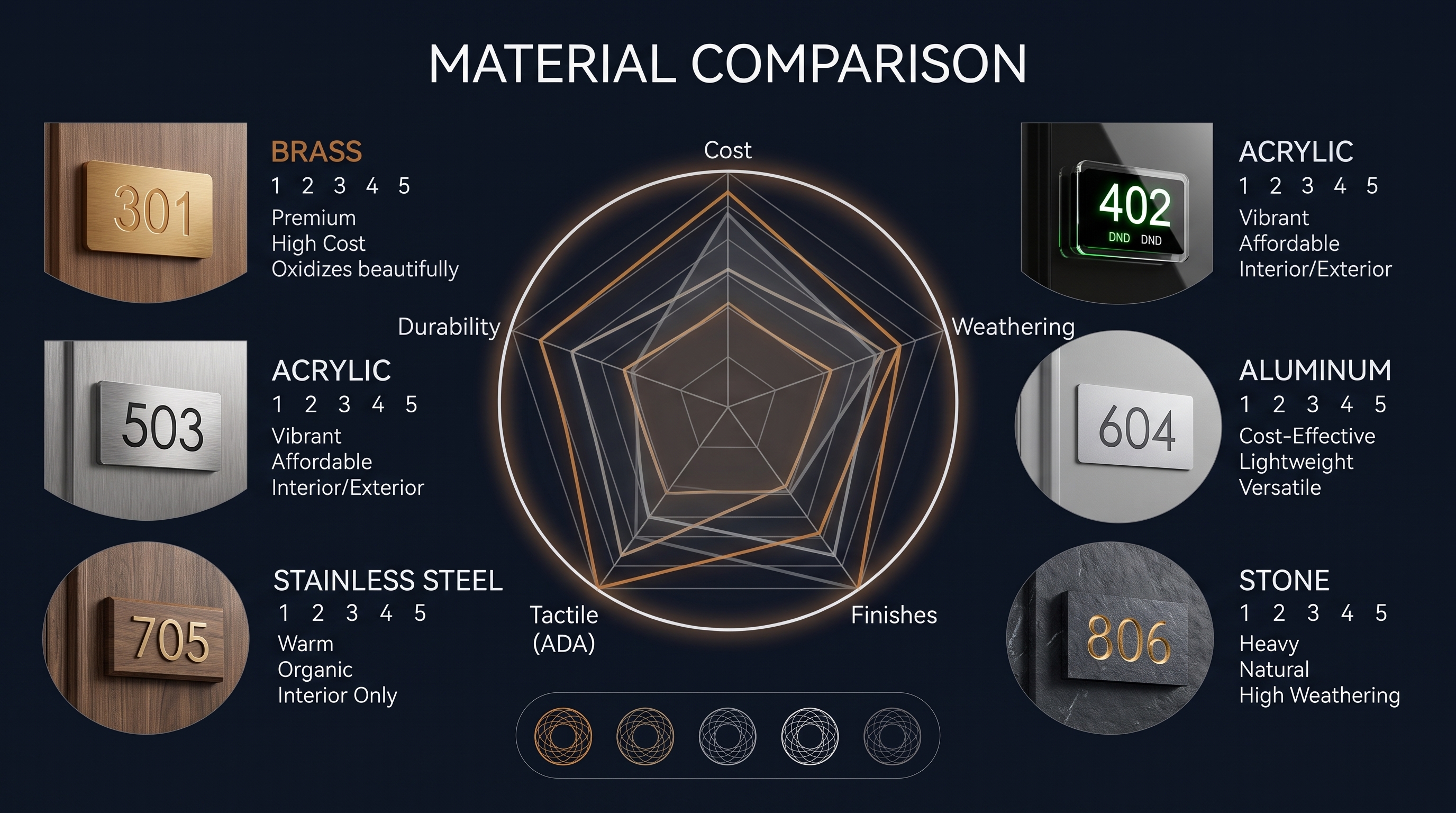
Brass hotel door signs cost breakdown is the most strategic financial analysis a hotel procurement team performs when specifying premium door identification systems. Unlike generic hotel door signs, brass hotel door signs carry a unit cost 3 to 5 times higher than acrylic alternatives, and the per-room cost compounds across hundreds of rooms in a typical property. The brass hotel door signs cost breakdown analysis must consider material grade, finish selection, engraving labor, fastener specification, and volume tier to arrive at a defensible per-room budget that aligns with brand standards and total cost of ownership expectations. This brass hotel door signs cost breakdown guide walks procurement teams through the cost structure of premium brass door signs, the volume tiering that affects per-room pricing, and the negotiation levers that procurement teams can use to optimize the total project cost.
Brass hotel door signs are the premium specification for upscale and luxury hotel properties, with a typical service life of 10 to 15 years in indoor hospitality corridors. The cost premium over acrylic, aluminum, and other alternative materials is significant, but the cost premium is justified by the brand positioning, the perceived quality at the moment of room approach, and the long-term durability that reduces replacement frequency. The brass hotel door signs cost breakdown must therefore be framed as a 10 to 15 year lifecycle cost rather than a first-cost comparison, because the lifecycle cost often reveals that brass is more cost-effective than the lower-cost alternatives when replacement labor and material waste are included in the comparison.
Why Brass Hotel Door Signs Cost Justifies the Premium
Brass hotel door signs cost justifies the premium because the material delivers a combination of brand communication, guest experience impact, and long-term durability that no alternative material can replicate. The upfront cost premium is recovered through several mechanisms that the brass hotel door signs cost breakdown analysis must quantify to be defensible to the procurement review board. The first mechanism is the brand impression value, which is the marginal revenue impact of a guest who perceives the property as premium because of the door sign quality at the moment of room approach. The second mechanism is the replacement frequency reduction, which is the avoided labor and material cost of replacing worn or damaged signs over the 10 to 15 year service life. The third mechanism is the maintenance labor reduction, which is the avoided polishing and touch-up labor compared to alternative materials that require more frequent maintenance.
Brass hotel door signs cost justification requires a structured analysis that compares the total cost of ownership across materials. The total cost of ownership includes the unit price, the installation labor, the routine maintenance labor, the replacement frequency, the replacement labor, and the end-of-life disposal or recycling cost. The brass hotel door signs cost breakdown analysis typically reveals that brass signage delivers a lower total cost of ownership than acrylic signage for upscale properties over a 10 to 15 year service life, despite the higher upfront unit cost. This total cost of ownership advantage is the strongest financial argument for the brass specification and is the lever that procurement teams use to defend the specification against cost-reduction pressure from the property finance team.
The brass hotel door signs cost justification also extends to the property revenue model. A luxury property that underspecifies its signage system creates a visible quality gap that undermines the premium positioning and the rate per night that the property can charge. A luxury property that overspecifies its signage system wastes budget that could be redirected to higher-leverage guest experience investments. The brass hotel door signs cost breakdown analysis is therefore as much a brand positioning exercise as a procurement exercise, and the optimal specification balances the cost premium against the brand impact to arrive at a specification that supports the property revenue model.
The brass hotel door signs cost breakdown analysis is also a critical input to the property financial planning and the capex budget allocation. The procurement team that presents a comprehensive cost breakdown to the property finance team is better positioned to defend the brass specification against the cost-reduction pressure that is typical in the annual budgeting cycle. The cost breakdown analysis should include the unit price, the volume tier discount, the installation labor, the routine maintenance labor, the replacement frequency, the lifecycle cost, and the brand positioning value, with each line item supported by a defensible data source. The procurement team that presents the cost breakdown analysis in this structured format is more likely to secure the brass specification approval than the procurement team that presents only the unit price comparison.
The brass hotel door signs cost breakdown analysis must also account for the indirect costs that are not captured in the unit price. The indirect costs include the property disruption during the installation, the brand impact during the property disruption, the staff training for the maintenance protocol, the warranty claim process, and the end-of-life recycling logistics. The indirect costs are typically 5 to 15 percent of the total project cost, and the procurement team that accounts for the indirect costs in the cost breakdown analysis is more likely to identify the total cost optimization opportunities than the procurement team that focuses only on the direct costs.
Brass Hotel Door Signs Material Grade Cost Tiers
Brass hotel door signs material grade cost tiers define the primary cost dimension in the brass hotel door signs cost breakdown analysis, and the material grade selection drives the per-room cost more than any other specification axis. The brass hotel door signs cost breakdown analysis typically presents three material grade tiers that align with the property brand tier and the budget allocation per room. The first tier is the standard brass grade, which is the baseline specification for most upscale hotel projects. The second tier is the premium brass grade, which is the specification for luxury properties and high-visibility areas such as the executive suites and the presidential suite. The third tier is the architectural brass grade, which is the specification for flagship properties, signature suites, and architecturally significant areas.
The standard brass grade for hotel door signs is typically C36000 free-machining brass, which is the industry standard for engraving and mechanical fabrication. The C36000 grade delivers adequate durability for indoor hotel corridors at a moderate cost, with a typical per-room unit cost of $15 to $30 depending on the size, the finish, and the engraving complexity. The brass hotel door signs cost breakdown analysis treats the C36000 grade as the baseline and applies cost multipliers for the higher grade materials and the more complex finishes.
The premium brass grade for hotel door signs is typically C26000 cartridge brass or C46400 naval brass, which delivers superior corrosion resistance and a more refined grain structure for the higher-end finishes. The premium grade carries a 30 to 60 percent cost premium over the C36000 grade, with a typical per-room unit cost of $25 to $50. The brass hotel door signs cost breakdown analysis applies the premium grade specification to the executive suites, the boardrooms, the high-visibility guest rooms, and the public areas where the guest perception of quality is most sensitive.
The architectural brass grade for hotel door signs is typically C22000 commercial bronze or C69300 silicon bronze, which delivers the highest durability and the most refined finish options for the most demanding applications. The architectural grade carries a 100 to 200 percent cost premium over the C36000 grade, with a typical per-room unit cost of $40 to $80 or higher for the most demanding applications. The brass hotel door signs cost breakdown analysis applies the architectural grade specification sparingly, typically for the presidential suite, the flagship entrance signage, and the architecturally significant public areas where the material specification is part of the broader architectural design intent.
Brass Hotel Door Signs Finish Cost Impact
Brass hotel door signs finish cost impact is the second major cost dimension in the brass hotel door signs cost breakdown analysis, and the finish selection can add 20 to 100 percent to the base material cost. The brass hotel door signs cost breakdown analysis typically presents four finish tiers that align with the material grade and the brand standard. The first finish is the polished brass finish, which is the baseline for the C36000 grade. The second finish is the satin brass finish, which is the most common for upscale properties. The third finish is the brushed brass finish, which provides a directional grain that is well suited to contemporary interiors. The fourth finish is the lacquer-protected or museum-grade finish, which is the premium specification for the most demanding applications.
The polished brass finish is the most reflective and the most traditional finish for brass hotel door signs, and it is also the most maintenance-intensive because the high gloss surface shows fingerprints, water spots, and tarnish more visibly than the matte finishes. The polished finish is typically priced at the baseline for the C36000 grade, with no premium over the unfinished brass material. The brass hotel door signs cost breakdown analysis treats the polished finish as the default specification, with the satin and brushed finishes priced as upgrades.
The satin brass finish is the most popular finish for upscale hotel properties, because the matte appearance reduces the visibility of fingerprints and minor scratches while preserving the warm brass tone that supports the brand positioning. The satin finish is typically priced at a 10 to 20 percent premium over the polished finish, which reflects the additional labor required to achieve the consistent matte appearance. The brass hotel door signs cost breakdown analysis treats the satin finish as the recommended default for most upscale properties, with the polished finish reserved for the traditional or classical interior design applications.
The brushed brass finish provides a directional grain that adds visual interest and that is well suited to contemporary interior design. The brushed finish is typically priced at a 20 to 40 percent premium over the polished finish, which reflects the additional labor required to apply the consistent directional grain. The brass hotel door signs cost breakdown analysis treats the brushed finish as the recommended specification for contemporary and modern interior design applications, particularly for properties with industrial or minimalist design themes.
The lacquer-protected or museum-grade finish is the premium specification for the most demanding applications, and it provides the longest service life with the lowest maintenance burden. The lacquer-protected finish is typically priced at a 40 to 100 percent premium over the polished finish, which reflects the additional material and labor required to apply the protective coating. The brass hotel door signs cost breakdown analysis treats the lacquer-protected finish as the recommended specification for flagship properties, signature suites, and architecturally significant areas where the maintenance burden of the unprotected finishes would be operationally unacceptable.
Brass Hotel Door Signs Engraving and Customization Cost
Brass hotel door signs engraving and customization cost is the third major cost dimension in the brass hotel door signs cost breakdown analysis, and the engraving complexity can add 20 to 80 percent to the base material and finish cost. The brass hotel door signs cost breakdown analysis typically distinguishes between standard engraving, custom engraving, and full customization. The standard engraving is the typical specification for most properties, with the room number, the brand logo, and the ADA braille content applied to the standard sign template. The custom engraving is the specification for properties that require unique typography, custom brand integration, or special design elements. The full customization is the specification for signature suites and architecturally significant areas that require bespoke design and fabrication.
The standard engraving cost for brass hotel door signs is typically included in the base unit price for the C36000 grade material with the standard finishes, because the engraving is performed on a CNC engraving machine with a standardized template. The standard engraving cost adds 5 to 15 percent to the base material and finish cost for the premium and architectural grades, which reflects the additional setup time for the larger materials and the more demanding engraving parameters. The brass hotel door signs cost breakdown analysis treats the standard engraving as the default specification, with the cost premium quantified for the higher grades.
The custom engraving cost for brass hotel door signs is typically priced at a 20 to 50 percent premium over the standard engraving, which reflects the additional design time, the additional setup time, and the additional fabrication labor required to apply the custom typography or the custom brand integration. The brass hotel door signs cost breakdown analysis treats the custom engraving as the recommended specification for properties with unique brand standards, with the cost premium quantified and the design approval process integrated into the procurement timeline.
The full customization cost for brass hotel door signs is typically priced at a 50 to 100 percent premium over the standard engraving, which reflects the bespoke design process, the bespoke fabrication setup, and the small-batch quality control required to deliver the customized product. The brass hotel door signs cost breakdown analysis treats the full customization as the recommended specification for signature suites and architecturally significant areas only, with the cost premium quantified and the quantity per property typically limited to a small number of pieces.
Brass Hotel Door Signs Volume Tier Pricing
Brass hotel door signs volume tier pricing is the fourth major cost dimension in the brass hotel door signs cost breakdown analysis, and the volume tier affects the per-room unit cost through the supplier's quantity discount structure. The brass hotel door signs cost breakdown analysis typically presents four volume tiers that align with the typical property size and the typical project scale. The first tier is the boutique tier, which covers properties with 30 to 100 rooms. The second tier is the midscale tier, which covers properties with 100 to 300 rooms. The third tier is the upscale tier, which covers properties with 300 to 600 rooms. The fourth tier is the large-scale tier, which covers properties with more than 600 rooms and multi-property chain deployments.
The boutique volume tier for brass hotel door signs typically commands a 30 to 50 percent premium per unit over the standard pricing, because the supplier must amortize the setup cost, the tooling cost, and the quality control cost across a smaller production run. The boutique tier per-room cost is typically in the range of $40 to $80 for the C36000 grade with the standard finish and the standard engraving. The brass hotel door signs cost breakdown analysis treats the boutique tier as the highest per-room cost tier, with the cost premium quantified and the quantity discount opportunity identified for properties considering chain-wide deployment.
The midscale volume tier for brass hotel door signs typically commands the standard per-unit pricing, with a small quantity discount of 5 to 15 percent over the boutique tier. The midscale tier per-room cost is typically in the range of $30 to $60 for the C36000 grade with the standard finish and the standard engraving. The brass hotel door signs cost breakdown analysis treats the midscale tier as the typical reference pricing for most upscale properties, with the per-room cost used as the baseline for the cost comparison against the alternative materials.
The upscale volume tier for brass hotel door signs typically commands a 15 to 30 percent quantity discount over the standard pricing, because the larger production run allows the supplier to optimize the material procurement, the fabrication labor, and the quality control process. The upscale tier per-room cost is typically in the range of $25 to $50 for the C36000 grade with the standard finish and the standard engraving. The brass hotel door signs cost breakdown analysis treats the upscale tier as the preferred pricing tier for properties with more than 300 rooms, with the cost savings quantified and the procurement leverage identified.
The large-scale volume tier for brass hotel door signs typically commands a 25 to 50 percent quantity discount over the standard pricing, because the multi-property chain deployment allows the supplier to optimize the material procurement, the fabrication labor, the quality control process, and the logistics handling. The large-scale tier per-room cost is typically in the range of $20 to $40 for the C36000 grade with the standard finish and the standard engraving. The brass hotel door signs cost breakdown analysis treats the large-scale tier as the preferred pricing tier for multi-property chain deployments, with the cost savings quantified and the procurement leverage identified.
Brass Hotel Door Signs Specification Checklist for Procurement Teams
A complete brass hotel door signs specification checklist consolidates the previous sections into a decision matrix that procurement teams can use to brief vendors and validate proposals. The first checklist item is material grade, which captures the C36000 standard, the C26000 or C46400 premium, or the C22000 or C69300 architectural grade. The second checklist item is finish specification, which captures the polished, satin, brushed, or lacquer-protected finish. The third checklist item is engraving complexity, which captures the standard, custom, or full customization engraving scope. The fourth checklist item is volume tier, which captures the boutique, midscale, upscale, or large-scale volume tier. The fifth checklist item is installation labor, which captures the fastener type, the substrate preparation, and the installation labor estimate. The sixth checklist item is supplier qualification, which captures the manufacturer certifications, the hospitality experience, the references from comparable properties, and the customization capability.
The seventh checklist item is brand standards, which captures the hotel chain brand book, the typography and color specifications, and the conformance to any prior properties in the chain. The eighth checklist item is warranty and after-sales support, which captures the defect replacement commitment, the labor coverage, the spare parts availability, and the response time for in-warranty claims. The ninth checklist item is total cost of ownership, which captures unit price, installation labor, replacement stock, routine maintenance labor, and expected replacement cycle over the 10 to 15 year service life. The tenth checklist item is sustainability, which captures the recycled content of the brass material, the end-of-life recyclability, and the manufacturer environmental management system.
Procurement teams that walk through this brass hotel door signs specification checklist before issuing a vendor RFQ typically achieve a 15 to 25 percent reduction in total project cost compared to teams that select on unit price alone, because the structured decision matrix exposes material grade, finish, engraving, and volume tier trade-offs that affect long-term cost but not initial quote. The brass hotel door signs cost breakdown guide is therefore as much a financial planning tool as it is a product specification resource.
Brass Hotel Door Signs Cost Comparison with Alternative Materials
Brass hotel door signs cost comparison with alternative materials is the analytical framework that allows procurement teams to defend the brass specification against cost-reduction pressure from the property finance team. The brass hotel door signs cost breakdown analysis typically presents a side-by-side comparison of the total cost of ownership across brass, acrylic, aluminum, stainless steel, and wood materials, with the comparison covering the unit price, the installation labor, the routine maintenance labor, the replacement frequency, and the end-of-life disposal cost. The total cost of ownership analysis typically reveals that brass delivers a lower 10 to 15 year cost than the lower-cost alternatives for upscale and luxury properties, despite the higher upfront unit cost.
The unit price comparison for brass hotel door signs versus alternative materials typically shows brass at $25 to $60 per room, acrylic at $5 to $20 per room, aluminum at $10 to $30 per room, stainless steel at $20 to $50 per room, and wood at $15 to $40 per room for the standard material grades with the standard finishes. The brass hotel door signs cost breakdown analysis treats the unit price as the first cost dimension, but emphasizes that the unit price is only one component of the total cost of ownership.
The installation labor comparison for brass hotel door signs versus alternative materials typically shows brass at $5 to $15 per room, acrylic at $2 to $5 per room, aluminum at $3 to $8 per room, stainless steel at $5 to $12 per room, and wood at $5 to $10 per room. The brass hotel door signs cost breakdown analysis treats the installation labor as the second cost dimension, with the labor differential reflecting the heavier weight of the brass material, the more robust fastener requirements, and the longer installation time per sign.
The routine maintenance labor comparison for brass hotel door signs versus alternative materials typically shows brass at $2 to $5 per room per year for polishing and touch-up, acrylic at $0.50 to $1 per room per year for routine cleaning, aluminum at $1 to $2 per room per year for routine cleaning, stainless steel at $1 to $2 per room per year for stainless cleaner application, and wood at $2 to $4 per room per year for refinishing and touch-up. The brass hotel door signs cost breakdown analysis treats the routine maintenance labor as the third cost dimension, with the brass maintenance labor partially offset by the longer replacement interval.
The replacement frequency comparison for brass hotel door signs versus alternative materials typically shows brass at 10 to 15 year replacement interval, acrylic at 5 to 7 year replacement interval, aluminum at 7 to 10 year replacement interval, stainless steel at 10 to 15 year replacement interval, and wood at 7 to 10 year replacement interval. The brass hotel door signs cost breakdown analysis treats the replacement frequency as the fourth cost dimension, with the longer brass replacement interval partially offsetting the higher upfront cost over the 10 to 15 year service life.
The total cost of ownership over a 10 to 15 year service life for brass hotel door signs is typically in the range of $40 to $100 per room, including the unit price, the installation labor, the routine maintenance labor, the replacement labor at the end of the service life, and the end-of-life disposal or recycling cost. The total cost of ownership for acrylic hotel door signs over the same period is typically in the range of $20 to $50 per room, for aluminum $30 to $70 per room, for stainless steel $35 to $80 per room, and for wood $30 to $70 per room. The brass hotel door signs cost breakdown analysis reveals that the cost premium of brass over the alternatives is partially or fully recovered over the service life, depending on the property maintenance protocol and the replacement frequency.
Brass Hotel Door Signs Negotiation Levers and Procurement Strategy
Brass hotel door signs negotiation levers and procurement strategy is the final dimension of the brass hotel door signs cost breakdown analysis, and the procurement team that understands the supplier cost structure can deploy targeted negotiation levers to optimize the total project cost. The brass hotel door signs cost breakdown analysis typically identifies four major negotiation levers that the procurement team can deploy to reduce the total project cost without compromising the material grade or the finish specification.
The first negotiation lever is the material grade standardization, which the procurement team can use to negotiate a volume discount by committing to a single material grade across the entire property. The brass hotel door signs cost breakdown analysis recommends that the procurement team avoid mixing material grades across the property, because the supplier setup cost, the tooling cost, and the quality control cost increase when multiple grades are specified. The single-grade commitment typically delivers a 5 to 15 percent quantity discount over the mixed-grade specification.
The second negotiation lever is the finish standardization, which the procurement team can use to negotiate a volume discount by committing to a single finish across the entire property. The brass hotel door signs cost breakdown analysis recommends that the procurement team avoid mixing finishes across the property, because the supplier setup cost and the quality control cost increase when multiple finishes are specified. The single-finish commitment typically delivers a 5 to 10 percent quantity discount over the mixed-finish specification.
The third negotiation lever is the engraving standardization, which the procurement team can use to negotiate a volume discount by committing to a single engraving template across the entire property. The brass hotel door signs cost breakdown analysis recommends that the procurement team avoid mixing engraving templates across the property, because the supplier setup cost and the quality control cost increase when multiple templates are specified. The single-template commitment typically delivers a 5 to 10 percent quantity discount over the mixed-template specification.
The fourth negotiation lever is the multi-property commitment, which the procurement team can use to negotiate a chain-wide volume discount by committing to the brass hotel door signs specification across multiple properties in the chain. The brass hotel door signs cost breakdown analysis recommends that chain operators with multiple properties under development negotiate a multi-property commitment, which typically delivers a 15 to 30 percent quantity discount over the single-property specification. The multi-property commitment also provides the supplier with the production planning stability that allows the supplier to optimize the material procurement, the fabrication labor, and the logistics handling.
Brass Hotel Door Signs Lifecycle and Cost Optimization
Brass hotel door signs lifecycle and cost optimization is the strategic framework that procurement teams use to capture the full value of the brass specification over the 10 to 15 year service life. The brass hotel door signs cost breakdown analysis reveals that the upfront cost premium of brass over the alternatives is partially or fully recovered through the longer service life, the lower maintenance burden, and the brand value alignment. The procurement team that plans the lifecycle and cost optimization strategy can capture additional value by aligning the replacement timing with the property renovation schedule, by negotiating extended warranties, and by standardizing the specification across the chain to leverage economies of scale.
The alignment of brass hotel door signs replacement timing with the property renovation schedule is the first lever that procurement teams can use to optimize the lifecycle cost. The brass hotel door signs typically reach the end of the service life at the same time as the property renovation cycle, which allows the property to replace the signage system as part of the broader renovation project rather than as a standalone capital expense. The brass hotel door signs cost breakdown analysis recommends that procurement teams align the replacement specification with the renovation schedule to capture the labor and disruption cost savings of a coordinated replacement.
The negotiation of extended warranties is the second lever that procurement teams can use to optimize the lifecycle cost. The brass hotel door signs cost breakdown analysis recommends that procurement teams negotiate extended warranties with the supplier to cover the fabrication defects, the finish defects, and the fastener failure for a period of 3 to 5 years. The extended warranty protection typically adds 2 to 5 percent to the total project cost but provides the financial protection that the procurement team needs to justify the upfront cost premium over the alternatives.
The standardization of the brass hotel door signs specification across the chain is the third lever that procurement teams can use to optimize the lifecycle cost. The brass hotel door signs cost breakdown analysis recommends that chain operators standardize the material grade, the finish, the engraving template, and the installation protocol across all properties in the chain. The specification standardization provides the procurement leverage that allows the chain to negotiate chain-wide volume discounts, to optimize the replacement logistics, and to reduce the training burden for the maintenance teams.
The brass hotel door signs lifecycle cost optimization is also a critical input to the brand standard governance process that the chain procurement team operates. The chain procurement team that captures the brass hotel door signs cost data across multiple properties can build a comprehensive cost benchmark that informs the brand standard specification for future properties. The benchmark data allows the chain procurement team to identify the properties that are spending above the brand standard benchmark, the properties that are achieving below-average lifecycle cost, and the suppliers that are delivering above-average value. The benchmark-driven brand standard governance process is the ultimate optimization lever for the chain-wide brass hotel door signs specification, and the brass hotel door signs cost breakdown analysis is the data source that powers the optimization.
The brass hotel door signs specification should also account for the brand evolution that occurs over the 10 to 15 year service life. The brand identity of a hotel chain typically evolves every 3 to 5 years through brand refresh cycles, and the door sign specification may need to evolve with the brand identity. The brass hotel door signs cost breakdown analysis recommends that the procurement team plan for the brand evolution by specifying a modular engraving system that allows the typography and the brand logo to be updated without replacing the entire sign. The modular engraving system typically adds 5 to 10 percent to the initial unit cost but allows the property to capture the brand evolution savings over the service life. The modular approach also allows the property to use the same brass substrate across multiple brand refresh cycles, which reduces the material waste and the disposal cost.
The brass hotel door signs specification should also be coordinated with the broader architectural material palette of the property. The door sign material, finish, and engraving should align with the door hardware, the corridor lighting, the wall finishes, and the floor finishes to deliver a coherent material narrative that supports the brand positioning. The brass hotel door signs cost breakdown analysis recommends that the procurement team coordinate the sign specification with the architectural team and the interior design team from the design development phase, because retrofitting the sign specification to align with the architectural palette is a common source of cost overruns and installation delays. The coordinated specification approach typically delivers 5 to 15 percent total project cost savings through the elimination of the retrofit requirements and the optimization of the installation logistics.
Part of this article content is generated by AI and optimized for professional accuracy and readability.
Not sure which sensor fits your project?
Talk to our mmWave application engineers for a free consultation.
Specify your hotel project with our engineers
Send your room count, ceiling type, and protocol preference. We will return a sample plan and quote within 24 business hours.
- Move from general guidance into a product or application discussion.
- Use RFQ when pricing, drawings, MOQ, or launch timing needs structure.
- Keep a direct contact path visible for fast clarifications and handoff.