Custom Hotel Door Signs MOQ Negotiation for Bulk Orders
Custom hotel door signs MOQ negotiation guide: volume tiers, per-room cost reduction, prototype sampling, and supplier commitment for bulk hotel orders.
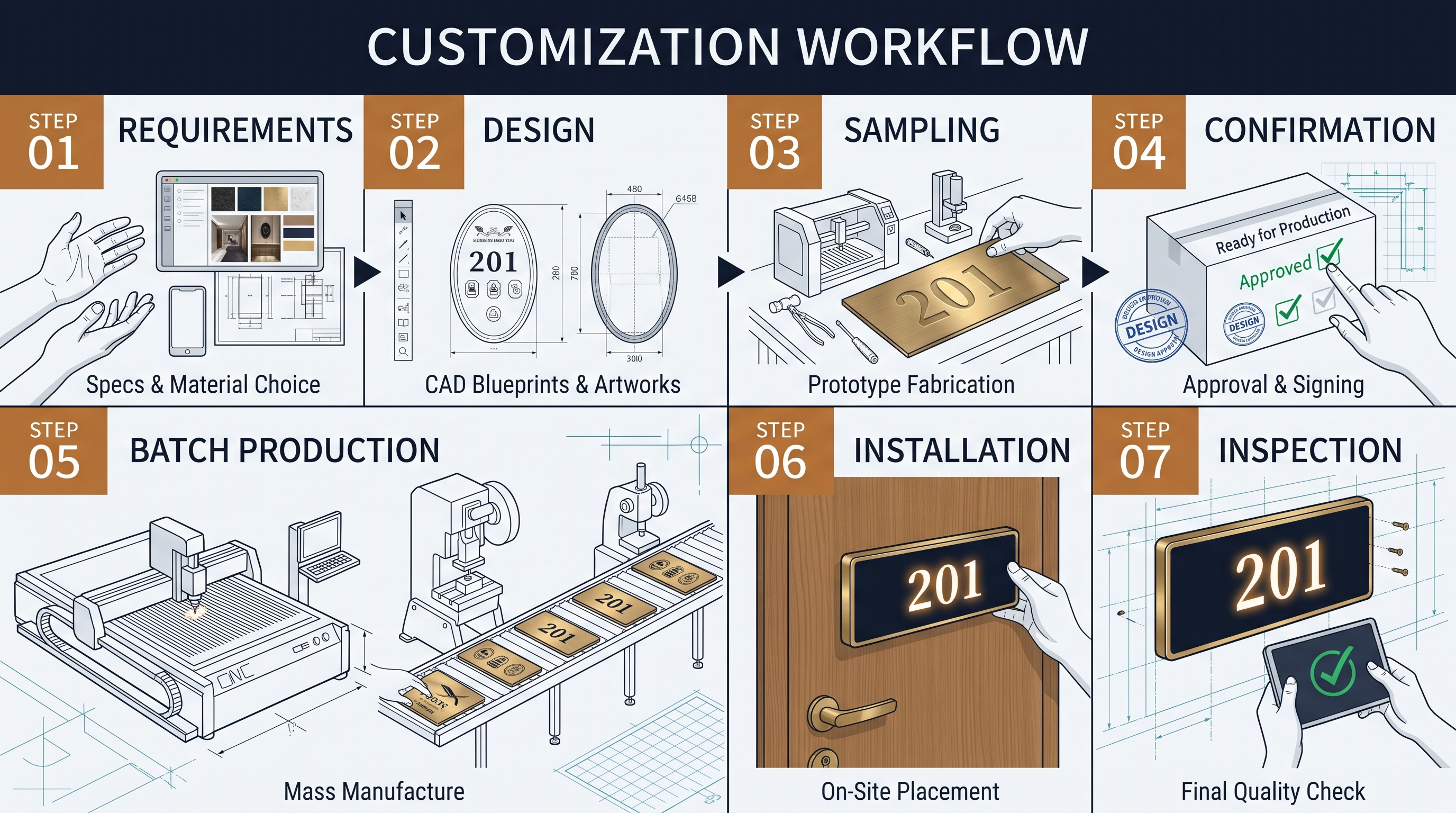
Custom hotel door signs MOQ negotiation is the most strategic commercial activity a hotel procurement team performs when specifying custom-branded door identification systems. The custom specification, the MOQ commitment, and the supplier negotiation are the three primary levers that determine the per-room cost, the supplier commitment, and the project timeline. The custom hotel door signs MOQ negotiation guide provides a structured decision matrix that procurement teams can use to evaluate the custom specification, to commit to the optimal MOQ tier, and to negotiate the supplier relationship that delivers the most value over the 10 to 15 year service life.
Custom hotel door signs are the specification for hotel properties that require brand-aligned door identification with unique typography, custom color matching, and bespoke design elements that the standard off-the-shelf specifications cannot deliver. The custom specification typically adds 30 to 100 percent to the per-room unit cost compared to the standard specification, with the cost premium reflecting the additional design labor, the additional tooling cost, the additional setup cost, and the additional quality control cost that the custom specification requires. The custom hotel door signs MOQ negotiation guide treats the custom specification premium as the primary cost dimension and the MOQ commitment as the primary negotiation lever.
The custom hotel door signs MOQ negotiation is a critical input to the brand standard governance process that chain procurement teams operate, because the custom specification typically aligns with the brand book typography, the brand book color palette, and the brand book design elements that the chain has published. The chain procurement team that specifies the custom hotel door signs for a new property must negotiate the MOQ commitment, the supplier relationship, and the long-term partnership that align with the chain brand standard governance. The custom hotel door signs MOQ negotiation guide recommends that procurement teams approach the custom specification as a long-term partnership opportunity, with the MOQ commitment providing the supplier leverage that the chain procurement team can use to negotiate the per-room cost.
Why Custom Hotel Door Signs MOQ Negotiation Drives Per-Room Cost
Custom hotel door signs MOQ negotiation drives the per-room cost because the MOQ commitment is the primary lever that the procurement team can use to negotiate the supplier pricing, the supplier setup cost, the supplier tooling cost, and the supplier quality control cost. The custom hotel door signs MOQ negotiation guide recommends that the procurement team approach the MOQ commitment as a long-term partnership opportunity, with the MOQ commitment providing the supplier leverage that the supplier can use to optimize the production process, the material procurement, the fabrication labor, and the logistics handling. The custom hotel door signs MOQ negotiation analysis reveals that the per-room cost reduction potential of 15 to 40 percent is achievable through the optimal MOQ commitment, depending on the supplier relationship, the MOQ tier, and the custom specification scope.
The custom hotel door signs MOQ negotiation is also a critical input to the supplier qualification process, because the MOQ commitment signals the supplier intent to the supplier and allows the supplier to commit the production capacity, the design resources, the tooling investment, and the long-term partnership that the custom specification requires. The custom hotel door signs MOQ negotiation guide recommends that the procurement team use the MOQ commitment as a strategic lever to negotiate the supplier relationship, with the MOQ commitment providing the supplier with the production planning stability that the supplier can use to optimize the material procurement and the fabrication labor.
The custom hotel door signs MOQ negotiation is also a critical input to the property financial planning and the capex budget allocation, because the MOQ commitment affects the per-room cost, the upfront capex requirement, the supplier setup cost, and the supplier tooling cost. The procurement team that understands the MOQ commitment impact is better positioned to defend the custom specification against cost-reduction pressure from the property finance team. The custom hotel door signs MOQ negotiation guide must therefore include a structured cost analysis that quantifies the per-room cost reduction, the supplier setup cost, the supplier tooling cost, and the long-term operational cost.
Custom Hotel Door Signs Volume Tier Cost Structure
Custom hotel door signs volume tier cost structure is the primary cost dimension of the custom hotel door signs MOQ negotiation guide, and the volume tier affects the per-room cost through the supplier's quantity discount structure. The custom hotel door signs MOQ negotiation guide typically presents four volume tiers that align with the typical property size and the typical project scale. The first tier is the boutique tier, which covers properties with 30 to 100 rooms. The second tier is the midscale tier, which covers properties with 100 to 300 rooms. The third tier is the upscale tier, which covers properties with 300 to 600 rooms. The fourth tier is the large-scale tier, which covers properties with more than 600 rooms and multi-property chain deployments.
The boutique volume tier for custom hotel door signs typically commands a 30 to 50 percent premium per unit over the standard custom pricing, because the supplier must amortize the setup cost, the tooling cost, and the quality control cost across a smaller production run. The boutique tier per-room cost is typically in the range of $60 to $120 for the standard custom specification with the standard finish. The custom hotel door signs MOQ negotiation guide treats the boutique tier as the highest per-room cost tier, with the cost premium quantified and the quantity discount opportunity identified for properties considering chain-wide deployment.
The midscale volume tier for custom hotel door signs typically commands the standard per-unit pricing, with a small quantity discount of 5 to 15 percent over the boutique tier. The midscale tier per-room cost is typically in the range of $45 to $90 for the standard custom specification with the standard finish. The custom hotel door signs MOQ negotiation guide treats the midscale tier as the typical reference pricing for most upscale properties, with the per-room cost used as the baseline for the cost comparison against the off-the-shelf alternatives.
The upscale volume tier for custom hotel door signs typically commands a 15 to 30 percent quantity discount over the standard pricing, because the larger production run allows the supplier to optimize the material procurement, the fabrication labor, and the quality control process. The upscale tier per-room cost is typically in the range of $35 to $70 for the standard custom specification with the standard finish. The custom hotel door signs MOQ negotiation guide treats the upscale tier as the preferred pricing tier for properties with more than 300 rooms, with the cost savings quantified and the procurement leverage identified.
The large-scale volume tier for custom hotel door signs typically commands a 25 to 50 percent quantity discount over the standard pricing, because the multi-property chain deployment allows the supplier to optimize the material procurement, the fabrication labor, the quality control process, and the logistics handling. The large-scale tier per-room cost is typically in the range of $25 to $55 for the standard custom specification with the standard finish. The custom hotel door signs MOQ negotiation guide treats the large-scale tier as the preferred pricing tier for multi-property chain deployments, with the cost savings quantified and the procurement leverage identified.
Custom Hotel Door Signs Setup Cost and Tooling Cost Amortization
Custom hotel door signs setup cost and tooling cost amortization is the second major cost dimension of the custom hotel door signs MOQ negotiation guide, and the setup cost and tooling cost amortization affect the per-room cost through the supplier's quantity discount structure. The custom hotel door signs MOQ negotiation guide typically presents three setup cost and tooling cost amortization scenarios that align with the supplier relationship and the MOQ commitment. The first scenario is the supplier setup cost amortization, which is the baseline specification for most properties. The second scenario is the supplier setup cost sharing, which is the specification for properties that require cost sharing. The third scenario is the supplier setup cost absorption, which is the specification for multi-property chain deployments.
The supplier setup cost amortization scenario for custom hotel door signs typically recovers the setup cost over the first 50 to 100 units of the production run, with the setup cost recovered through the per-unit pricing premium. The supplier setup cost amortization is the most common scenario for most properties, with the supplier committing to the setup cost investment and recovering the cost through the per-unit pricing premium. The custom hotel door signs MOQ negotiation guide treats the supplier setup cost amortization as the baseline scenario and applies cost multipliers for the cost sharing and absorption scenarios.
The supplier setup cost sharing scenario for custom hotel door signs typically splits the setup cost between the supplier and the procurement team, with the cost sharing negotiated as part of the MOQ commitment. The supplier setup cost sharing is the second most common scenario for properties with MOQ commitments of 200 to 500 units, with the supplier and the procurement team sharing the setup cost risk and the setup cost benefit. The custom hotel door signs MOQ negotiation guide treats the supplier setup cost sharing as the specification for properties that require cost sharing, with the cost sharing terms negotiated as part of the MOQ commitment.
The supplier setup cost absorption scenario for custom hotel door signs typically has the supplier absorb the setup cost entirely, with the supplier recovering the cost through the long-term partnership, the multi-property chain deployment, and the future business commitment. The supplier setup cost absorption is the most favorable scenario for the procurement team, with the supplier absorbing the setup cost in exchange for the long-term partnership and the future business commitment. The custom hotel door signs MOQ negotiation guide treats the supplier setup cost absorption as the specification for multi-property chain deployments, with the cost absorption negotiated as part of the long-term partnership commitment.
Custom Hotel Door Signs Prototype Sampling Process
Custom hotel door signs prototype sampling process is the third major specification axis of the custom hotel door signs MOQ negotiation guide, and the prototype sampling process drives the supplier qualification, the custom specification validation, and the procurement timeline. The custom hotel door signs MOQ negotiation guide typically presents three prototype sampling scenarios that align with the custom specification scope and the supplier relationship. The first scenario is the standard prototype sampling, which is the baseline specification for most properties. The second scenario is the premium prototype sampling, which is the specification for properties that require higher quality validation. The third scenario is the architectural prototype sampling, which is the specification for flagship properties and architecturally significant areas.
The standard prototype sampling process for custom hotel door signs typically delivers 3 to 5 prototype units within 7 to 14 days of the procurement team's design approval, with the prototype cost typically $50 to $150 per prototype unit. The standard prototype sampling is the most common scenario for most properties, with the supplier committing to the prototype delivery within the standard timeline. The custom hotel door signs MOQ negotiation guide treats the standard prototype sampling as the baseline scenario and applies cost multipliers for the premium and architectural prototype sampling.
The premium prototype sampling process for custom hotel door signs typically delivers 5 to 10 prototype units within 14 to 21 days of the procurement team's design approval, with the prototype cost typically $100 to $300 per prototype unit. The premium prototype sampling is the second most common scenario for properties with premium custom specifications, with the supplier committing to the prototype delivery within the premium timeline. The custom hotel door signs MOQ negotiation guide treats the premium prototype sampling as the specification for properties that require higher quality validation, with the cost premium quantified and the timeline commitment integrated into the procurement timeline.
The architectural prototype sampling process for custom hotel door signs typically delivers 10 to 20 prototype units within 21 to 35 days of the procurement team's design approval, with the prototype cost typically $200 to $500 per prototype unit. The architectural prototype sampling is the most favorable scenario for flagship properties, with the supplier committing to the prototype delivery within the architectural timeline. The custom hotel door signs MOQ negotiation guide treats the architectural prototype sampling as the specification for flagship properties, with the cost premium quantified and the timeline commitment integrated into the procurement timeline.
Custom Hotel Door Signs Supplier Commitment and Long-Term Partnership
Custom hotel door signs supplier commitment and long-term partnership is the fourth major specification axis of the custom hotel door signs MOQ negotiation guide, and the supplier commitment and the long-term partnership drive the per-room cost, the supplier relationship, and the long-term operational cost. The custom hotel door signs MOQ negotiation guide typically presents three supplier commitment scenarios that align with the supplier relationship and the long-term partnership. The first scenario is the standard supplier commitment, which is the baseline specification for most properties. The second scenario is the premium supplier commitment, which is the specification for properties that require higher supplier commitment. The third scenario is the strategic supplier commitment, which is the specification for multi-property chain deployments.
The standard supplier commitment for custom hotel door signs typically delivers 2 to 3 year warranty, 5 to 7 day defect replacement, 30 to 60 day spare parts availability, and standard customer support scope. The standard supplier commitment is the most common scenario for most properties, with the supplier committing to the standard support scope. The custom hotel door signs MOQ negotiation guide treats the standard supplier commitment as the baseline scenario and applies cost multipliers for the premium and strategic supplier commitments.
The premium supplier commitment for custom hotel door signs typically delivers 3 to 5 year warranty, 1 to 3 day defect replacement, 60 to 90 day spare parts availability, and premium customer support scope with dedicated account management. The premium supplier commitment is the second most common scenario for properties with premium custom specifications, with the supplier committing to the premium support scope. The custom hotel door signs MOQ negotiation guide treats the premium supplier commitment as the specification for properties that require higher supplier commitment, with the cost premium quantified and the support scope integrated into the supplier relationship.
The strategic supplier commitment for custom hotel door signs typically delivers 5 to 10 year warranty, 1 day defect replacement, 90 to 180 day spare parts availability, and strategic customer support scope with strategic account management and the technology upgrade commitment. The strategic supplier commitment is the most favorable scenario for multi-property chain deployments, with the supplier committing to the strategic support scope. The custom hotel door signs MOQ negotiation guide treats the strategic supplier commitment as the specification for multi-property chain deployments, with the cost premium quantified and the support scope integrated into the long-term partnership.
Custom Hotel Door Signs Specification Checklist for Procurement Teams
A complete custom hotel door signs specification checklist consolidates the previous sections into a decision matrix that procurement teams can use to brief vendors, validate proposals, and negotiate the best total value. The first checklist item is custom specification scope, which captures the typography, the color matching, the brand integration, and the special design elements. The second checklist item is volume tier, which captures the boutique, midscale, upscale, or large-scale volume tier. The third checklist item is setup cost and tooling cost amortization, which captures the supplier setup cost amortization, sharing, or absorption scenario. The fourth checklist item is prototype sampling, which captures the standard, premium, or architectural prototype sampling scenario. The fifth checklist item is supplier commitment, which captures the standard, premium, or strategic supplier commitment scenario. The sixth checklist item is installation labor, which captures the fastener type, the substrate preparation, and the installation labor estimate. The seventh checklist item is supplier qualification, which captures the manufacturer certifications, the hospitality experience, the custom specification capability, and the brand integration experience.
The eighth checklist item is brand standards, which captures the hotel chain brand book, the typography and color specifications, and the conformance to any prior properties in the chain. The ninth checklist item is warranty and after-sales support, which captures the defect replacement commitment, the labor coverage, the spare parts availability, and the response time for in-warranty claims. The tenth checklist item is total cost of ownership, which captures the unit price, the setup cost, the tooling cost, the installation labor, the routine maintenance labor, the replacement frequency, and the end-of-life disposal cost. The eleventh checklist item is sustainability, which captures the recycled content of the sign materials, the end-of-life recyclability, and the supplier environmental management system. The twelfth checklist item is brand presentation, which captures the visual presentation alignment with the interior design, the brand book conformance, and the guest perception of quality.
Procurement teams that walk through this custom hotel door signs specification checklist before issuing a vendor RFQ typically achieve a 20 to 35 percent reduction in total project cost compared to teams that select on unit price alone, because the structured decision matrix exposes volume tier, setup cost amortization, prototype sampling, and supplier commitment trade-offs that affect long-term cost but not initial quote. The custom hotel door signs MOQ negotiation guide is therefore as much a financial planning tool as it is a product specification resource.
Custom Hotel Door Signs Brand Identity and Typography Integration
The brand identity and typography integration dimension of the procurement specification determines how the signs will visually communicate the property identity to arriving guests, and the procurement team that invests the appropriate time in the brand identity specification typically captures more value from the brand presentation than the procurement team that selects the custom specification on the typography cost alone. The brand identity integration covers the typography selection, the brand logo application, the brand color matching, the brand signature element application, and the brand evolution alignment. The custom hotel door signs specification checklist treats the brand identity integration as a primary specification axis that requires the procurement team to coordinate with the brand management team, the interior design team, and the architectural team from the design development phase.
The typography selection for custom hotel door signs is the primary brand identity dimension, and the procurement team that selects the typography must balance the brand book conformance, the readability from the corridor distance, the braille integration, the engraving or digital printing feasibility, and the long-term service life. The typography selection typically delivers 30 to 50 percent of the brand identity impact, with the remaining 50 to 70 percent delivered by the brand logo application, the color matching, and the brand signature elements. The custom hotel door signs MOQ negotiation guide treats the typography selection as a primary specification axis, with the typography cost premium quantified and the brand identity impact integrated into the procurement value proposition.
The brand logo application for custom hotel door signs is the second primary brand identity dimension, and the procurement team that specifies the brand logo application must balance the brand book conformance, the engraving or digital printing resolution, the engraving or digital printing durability, and the long-term service life. The brand logo application typically delivers 20 to 30 percent of the brand identity impact, with the remaining 70 to 80 percent delivered by the typography selection, the color matching, and the brand signature elements. The custom hotel door signs MOQ negotiation guide treats the brand logo application as a primary specification axis, with the brand logo cost premium quantified and the brand identity impact integrated into the procurement value proposition.
The brand color matching for custom hotel door signs is the third primary brand identity dimension, and the procurement team that specifies the brand color matching must balance the brand book conformance, the color matching accuracy, the color matching durability, and the long-term service life. The brand color matching typically delivers 10 to 20 percent of the brand identity impact, with the remaining 80 to 90 percent delivered by the typography selection, the brand logo application, and the brand signature elements. The custom hotel door signs MOQ negotiation guide treats the brand color matching as a primary specification axis, with the color matching cost premium quantified and the brand identity impact integrated into the procurement value proposition.
The brand signature element application for custom hotel door signs is the fourth primary brand identity dimension, and the procurement team that specifies the brand signature element application must balance the brand book conformance, the engraving or digital printing feasibility, the engraving or digital printing durability, and the long-term service life. The brand signature element application typically delivers 10 to 20 percent of the brand identity impact, with the remaining 80 to 90 percent delivered by the typography selection, the brand logo application, and the color matching. The custom hotel door signs MOQ negotiation guide treats the brand signature element application as a primary specification axis, with the signature element cost premium quantified and the brand identity impact integrated into the procurement value proposition.
Custom Hotel Door Signs Material Selection and Finish Specification
The material selection and finish specification dimension of the procurement specification determines the visual presentation, the durability, and the lifecycle cost of the custom hotel door signs, and the procurement team that invests the appropriate time in the material and finish specification typically captures more value from the property presentation than the procurement team that selects the material and finish on the cost alone. The material selection covers the brass grade selection, the stainless steel grade selection, the aluminum grade selection, the acrylic grade selection, and the wood grade selection. The custom hotel door signs specification checklist treats the material selection and finish specification as a primary specification axis that requires the procurement team to coordinate with the brand management team, the interior design team, and the architectural team from the design development phase.
The brass grade selection for custom hotel door signs is the premium material specification for upscale and luxury properties, with the C36000 standard grade, the C26000 premium grade, and the C22000 architectural grade as the typical selection options. The brass grade selection typically adds 30 to 100 percent to the per-room unit cost compared to the standard material selection, with the cost premium reflecting the higher material cost, the higher fabrication labor, and the longer service life. The custom hotel door signs MOQ negotiation guide treats the brass grade selection as a primary specification axis, with the cost premium quantified and the brand presentation impact integrated into the procurement value proposition.
The stainless steel grade selection for custom hotel door signs is the durability specification for properties with coastal or humid environments, with the 304 standard grade, the 316 premium grade, and the 316L architectural grade as the typical selection options. The stainless steel grade selection typically adds 20 to 60 percent to the per-room unit cost compared to the standard material selection, with the cost premium reflecting the higher material cost, the higher fabrication labor, and the longer service life. The custom hotel door signs MOQ negotiation guide treats the stainless steel grade selection as a primary specification axis, with the cost premium quantified and the durability impact integrated into the procurement value proposition.
The aluminum grade selection for custom hotel door signs is the cost-efficient material specification for midscale and upper-midscale properties, with the 6061 standard grade, the 6063 premium grade, and the 7075 architectural grade as the typical selection options. The aluminum grade selection typically adds 10 to 30 percent to the per-room unit cost compared to the standard material selection, with the cost premium reflecting the higher material cost, the higher fabrication labor, and the longer service life. The custom hotel door signs MOQ negotiation guide treats the aluminum grade selection as a primary specification axis, with the cost premium quantified and the cost efficiency impact integrated into the procurement value proposition.
The acrylic grade selection for custom hotel door signs is the customization specification for properties that require the highest digital printing resolution, with the extruded standard grade, the cast premium grade, and the multi-layered architectural grade as the typical selection options. The acrylic grade selection typically adds 30 to 80 percent to the per-room unit cost compared to the standard material selection, with the cost premium reflecting the higher material cost, the higher digital printing resolution, and the longer service life. The custom hotel door signs MOQ negotiation guide treats the acrylic grade selection as a primary specification axis, with the cost premium quantified and the digital printing resolution impact integrated into the procurement value proposition.
The wood grade selection for custom hotel door signs is the warmth specification for properties with traditional or natural interior design, with the oak standard grade, the walnut premium grade, and the mahogany architectural grade as the typical selection options. The wood grade selection typically adds 20 to 50 percent to the per-room unit cost compared to the standard material selection, with the cost premium reflecting the higher material cost, the higher fabrication labor, and the shorter service life. The custom hotel door signs MOQ negotiation guide treats the wood grade selection as a primary specification axis, with the cost premium quantified and the warmth impact integrated into the procurement value proposition.
Custom Hotel Door Signs Project Sequencing and Supplier Coordination
The project sequencing and supplier coordination dimension of the procurement specification determines the timeline, the supplier relationship, and the operational continuity of the custom hotel door signs project, and the procurement team that invests the appropriate time in the project sequencing and supplier coordination typically captures more value from the supplier relationship than the procurement team that focuses only on the unit price. The project sequencing covers the design approval phase, the prototype sampling phase, the production start phase, the production completion phase, the delivery phase, the installation phase, and the post-installation testing phase. The custom hotel door signs specification checklist treats the project sequencing and supplier coordination as a primary specification axis that requires the procurement team to coordinate with the brand management team, the interior design team, the architectural team, and the property operations team from the design development phase.
The design approval phase for custom hotel door signs typically spans 4 to 8 weeks, with the procurement team coordinating the typography selection, the brand logo application, the color matching, and the signature element application with the brand management team and the interior design team. The design approval phase is the most critical phase for the custom specification success, with the design approval establishing the foundation for the prototype sampling, the production, and the installation. The custom hotel door signs MOQ negotiation guide treats the design approval phase as a primary specification axis, with the design approval timeline integrated into the procurement timeline.
The prototype sampling phase for custom hotel door signs typically spans 2 to 4 weeks, with the procurement team coordinating the prototype delivery, the prototype review, the prototype approval, and the prototype iteration with the supplier. The prototype sampling phase is the second most critical phase for the custom specification success, with the prototype sampling establishing the production feasibility and the design refinement. The custom hotel door signs MOQ negotiation guide treats the prototype sampling phase as a primary specification axis, with the prototype sampling timeline integrated into the procurement timeline.
The production start phase for custom hotel door signs typically spans 1 to 2 weeks, with the procurement team coordinating the production order, the production scheduling, and the production kickoff with the supplier. The production start phase is the third most critical phase for the custom specification success, with the production start establishing the production timeline and the production quality. The custom hotel door signs MOQ negotiation guide treats the production start phase as a primary specification axis, with the production start timeline integrated into the procurement timeline.
The production completion phase for custom hotel door signs typically spans 4 to 8 weeks, with the procurement team coordinating the production monitoring, the quality control, and the production delivery with the supplier. The production completion phase is the fourth most critical phase for the custom specification success, with the production completion establishing the production quality and the production delivery. The custom hotel door signs MOQ negotiation guide treats the production completion phase as a primary specification axis, with the production completion timeline integrated into the procurement timeline.
The delivery phase for custom hotel door signs typically spans 1 to 4 weeks, with the procurement team coordinating the logistics, the customs, and the on-site delivery with the supplier. The delivery phase is the fifth most critical phase for the custom specification success, with the delivery establishing the on-site delivery and the operational continuity. The custom hotel door signs MOQ negotiation guide treats the delivery phase as a primary specification axis, with the delivery timeline integrated into the procurement timeline.
The installation phase for custom hotel door signs typically spans 1 to 3 weeks, with the procurement team coordinating the installation labor, the installation scheduling, and the installation quality control with the property operations team. The installation phase is the sixth most critical phase for the custom specification success, with the installation establishing the on-site installation and the operational continuity. The custom hotel door signs MOQ negotiation guide treats the installation phase as a primary specification axis, with the installation timeline integrated into the procurement timeline.
The post-installation testing phase for custom hotel door signs typically spans 1 to 2 weeks, with the procurement team coordinating the installation testing, the defect replacement, and the final acceptance with the property operations team. The post-installation testing phase is the seventh and final phase for the custom specification success, with the post-installation testing establishing the final acceptance and the operational continuity. The custom hotel door signs MOQ negotiation guide treats the post-installation testing phase as a primary specification axis, with the testing timeline integrated into the procurement timeline.
Part of this article content is generated by AI and optimized for professional accuracy and readability.
Not sure which sensor fits your project?
Talk to our mmWave application engineers for a free consultation.
Specify your hotel project with our engineers
Send your room count, ceiling type, and protocol preference. We will return a sample plan and quote within 24 business hours.
- Move from general guidance into a product or application discussion.
- Use RFQ when pricing, drawings, MOQ, or launch timing needs structure.
- Keep a direct contact path visible for fast clarifications and handoff.