Hotel Signage Solutions Guide for Property Procurement
Hotel signage solutions guide: room, wayfinding, safety, ADA, exterior, and digital signage by material, cost, and compliance for property procurement teams.
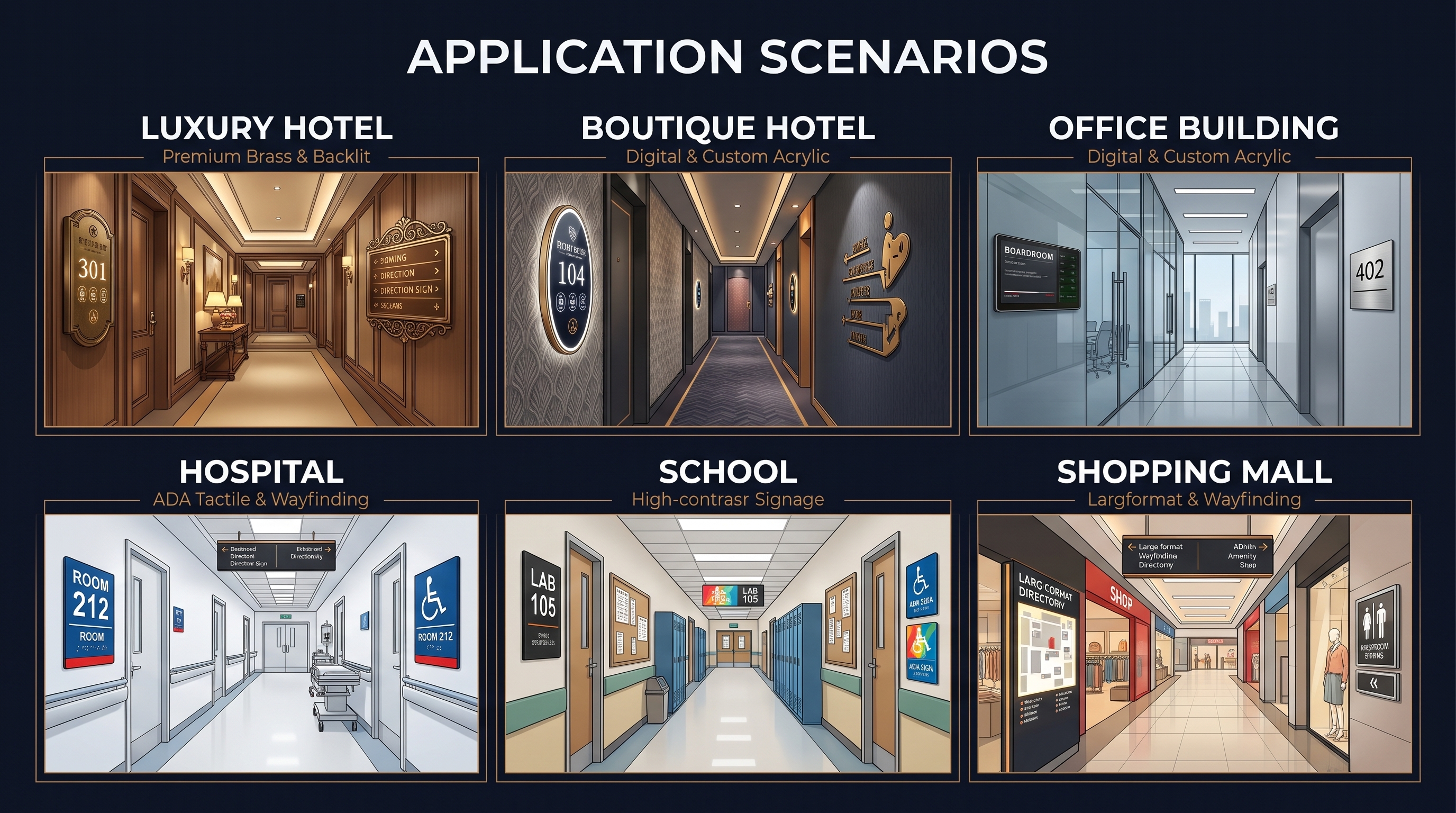
Hotel signage solutions are the integrated signage ecosystem that hospitality properties depend on for guest wayfinding, regulatory compliance, brand consistency, and operational efficiency across the entire built environment. A complete hotel signage solutions guide addresses the four essential decision axes a procurement team must resolve: which signage categories the property requires, which materials and mounting methods match the architectural context, which regulatory standards must be met, and how the signage system integrates with property management and energy management platforms. The hotel signage solutions category is broader than the individual room number sign or do not disturb sign discussed in other guides, and encompasses guest room identification, wayfinding, regulatory, ADA, exterior, and digital signage as a coordinated specification. For procurement teams, the right hotel signage solutions approach balances category coverage, material consistency, regulatory compliance, and total lifecycle cost across a multi-year asset life.
Hotel signage solutions are deployed as an integrated system rather than a collection of individual signs, because inconsistent signage across categories fragments the guest experience and undermines the brand identity. A property that specifies premium brass for guest room signs but uses printed acrylic for wayfinding signs, for example, creates a visible quality gap that guests perceive as inconsistent standards. The hotel signage solutions guide treats the procurement process as a single specification exercise that defines the material, finish, typography, and mounting standard for all signage categories, and then applies that standard uniformly across guest rooms, public areas, back of house, and exterior. This approach is the only way to achieve the brand consistency that hospitality guests expect at every property tier.
Why Hotel Signage Solutions Selection Drives Guest Experience and Compliance
Hotel signage solutions selection drives guest experience and compliance because the signage system is the primary visual infrastructure that guests use to navigate the property, identify the right room, understand safety information, and form impressions of the brand quality. Without a coordinated hotel signage solutions specification, a property may meet the minimum regulatory requirement for fire exit and ADA signage but fail to deliver the consistent brand experience that guests expect at the property tier. The hotel signage solutions category, when properly specified, eliminates the visual fragmentation that undermines brand perception and ensures that every sign in the property reinforces the same brand standard, the same typography, and the same material quality. The cost of poor hotel signage solutions selection is not just brand inconsistency but measurable guest experience degradation and regulatory exposure.
Hotel signage solutions must address multiple regulatory frameworks simultaneously, because hospitality properties are subject to fire code, ADA accessibility, building code, and brand standard requirements that may conflict in their specifications. A hotel signage solutions guide helps procurement teams navigate these regulatory layers and arrive at a specification that meets all applicable requirements without overspecifying on dimensions, materials, or installation methods. The right specification typically satisfies the most stringent applicable standard by default, which simplifies compliance and reduces the risk of regulatory conflict during the post-occupancy review.
Hotel signage solutions also carry a significant operational dimension beyond guest experience. A coordinated hotel signage solutions specification typically includes back-of-house signage for staff areas, maintenance rooms, mechanical spaces, and storage areas, which improves staff efficiency and reduces the time spent locating the right room during operational tasks. The hotel signage solutions guide treats back-of-house signage as a core category rather than an optional add-on, because the operational efficiency benefit of clear back-of-house signage typically exceeds the incremental cost within the first year of deployment.
The strategic dimension of hotel signage solutions selection extends to the property's broader brand and operational positioning. A luxury property that underspecifies its signage system creates a visible quality gap that undermines the premium positioning, while a mid-tier property that overspecifies its signage system wastes budget that could be redirected to higher-leverage guest experience investments. The hotel signage solutions guide helps procurement teams match the signage specification to the property tier and brand positioning, so that the signage investment is appropriate to the revenue model and guest expectation profile.
Hotel signage solutions selection also has a direct relationship with online guest reviews and reputation management. Guest reviews frequently comment on the difficulty of finding their room, the confusion of navigating the property, and the inconsistency of the signage quality. These complaints appear across review platforms and influence the booking decisions of prospective guests. A property with a well-designed and well-maintained hotel signage solutions system generates fewer navigation-related complaints and more positive brand perception reviews, which translates into measurable improvement in the online reputation score. The hotel signage solutions guide treats this reputation impact as a financial justification for investing in a coordinated signage specification, because the revenue impact of a half-point improvement in the online review score typically exceeds the total signage investment within 12 to 24 months.
The sustainability dimension of hotel signage solutions is also increasingly important as hospitality brands publish environmental commitments and as guests factor sustainability into their booking decisions. A signage specification that uses recycled-content materials, that specifies low-energy LED illumination, and that selects recyclable materials at end of life aligns with the property sustainability narrative and contributes to the brand's published environmental targets. The hotel signage solutions guide recommends that procurement teams request environmental product declarations from signage manufacturers and that the specification include a sustainability scoring criterion alongside the traditional cost, quality, and compliance criteria.
Hotel Signage Solutions Categories — Room, Wayfinding, Safety, ADA, Exterior, Digital
Hotel signage solutions categories define the scope of the specification, and a complete specification typically covers six or seven distinct categories. The first category is guest room identification, which includes door number signs, suite signs, and accessible room signs. The second category is do not disturb and room status signs, which include door hangers, magnetic signs, and LED status indicators. The third category is wayfinding signage, which includes elevator lobby directories, floor directories, corridor directional signs, and amenity signs such as restaurant, pool, fitness center, and business center. The fourth category is safety and regulatory signage, which includes fire exit signs, emergency evacuation maps, stairwell identification, and emergency contact information. The fifth category is ADA accessibility signage, which includes tactile room identification, accessible route signage, and assistive listening system signage. The sixth category is exterior and entrance signage, which includes monument signs, building identification, parking signage, and vehicular direction signs. The seventh category is digital signage, which includes lobby displays, meeting room boards, and back-of-house communication displays.
Each category has its own specification requirements, but the hotel signage solutions guide recommends a coordinated specification across all categories, with the same material standard, the same finish, the same typography, and the same mounting method where the application allows. This coordinated approach produces the brand consistency that guests perceive as quality, and it simplifies procurement by allowing the property to negotiate a single supplier relationship across the entire signage inventory. A property that procures each category from a different supplier often ends up with subtle variations in color, finish, and typography that fragment the visual identity.
The hotel signage solutions category scope also depends on the property tier. A limited-service property with 80 rooms may have a minimal signage inventory covering guest room signs, basic wayfinding, and fire exit signs, while a full-service luxury property with 500 rooms has a comprehensive inventory covering all seven categories plus specialized signage for spa, concierge, business center, and conference facilities. The hotel signage solutions guide recommends that the category scope be defined during the architectural programming phase, because the signage scope affects the electrical and infrastructure planning, the architectural detail drawings, and the procurement budget allocation.
The category scope also depends on the property operational model. A resort property with extensive outdoor areas and multiple buildings requires significantly more wayfinding and directional signage than an urban full-service property with a single building. A conference hotel with extensive meeting space requires significantly more meeting room signage and event direction signage than a leisure hotel with limited meeting facilities. The hotel signage solutions guide recommends that the category scope reflect the actual operational model and guest flow pattern of the property, rather than a generic category template that may under- or over-specify the signage inventory.
The category scope also includes an often-overlooked dimension: branded content signage that reinforces the brand narrative and local storytelling throughout the property. Modern hospitality branding increasingly incorporates story walls, historical panels, local art integration, and brand narrative displays that go beyond the functional room identification and wayfinding signage. The hotel signage solutions guide treats this branded content signage as a distinct subcategory that should be specified with the same material and finish standards as the functional signage, because the brand narrative signage is often the most photographed and most shared visual element of the property and therefore carries disproportionate brand exposure on social media and review platforms.
Hotel Signage Solutions Material Selection by Application
Hotel signage solutions material selection by application is the next decision axis after category scope, because the material choice varies by application environment, regulatory requirement, and brand standard. The hotel signage solutions guide recommends a tiered material selection with brass or anodized aluminum for guest room signs in upscale and luxury properties, acrylic for guest room signs in midscale and economy properties, photoluminescent or backlit acrylic for safety signage, aluminum or stainless steel for exterior signage, and tempered glass or high-grade acrylic for digital displays. The tiered approach balances the brand positioning, the regulatory requirement, and the total project budget.
Guest room identification in upscale and luxury properties typically uses brass, anodized aluminum, or solid surface materials such as Corian. The material communicates the brand quality at the moment of room approach and provides the durability required for the typical ten to fifteen year service life. The hotel signage solutions guide recommends brass for properties with traditional or classical interior design, anodized aluminum for properties with contemporary interior design, and solid surface for properties with custom material palettes that include other solid surface elements.
Guest room identification in midscale and economy properties typically uses acrylic, printed plastic, or thin aluminum composite. The material is more cost-efficient than brass or solid surface and provides adequate durability for the typical seven to ten year service life. The hotel signage solutions guide recommends acrylic with UV-stable inks and protective overlaminate for midscale properties, and printed plastic or aluminum composite for economy properties where the unit cost is the primary specification axis.
Safety and regulatory signage in all property tiers uses photoluminescent or backlit materials that meet the fire code and building code requirements. The hotel signage solutions guide recommends photoluminescent signage for exit routes and stairwell identification, because photoluminescent signage remains visible during power outages without battery backup, and recommends backlit or edge-lit LED signage for areas where higher visibility is required by code or by operational practice. The safety signage material must carry the appropriate certification from a recognized testing laboratory, and the procurement team must verify the certification before accepting the delivery.
Exterior and entrance signage uses anodized aluminum, stainless steel, or aluminum composite material with weather-resistant finish. The hotel signage solutions guide recommends anodized aluminum for monument signs and building identification, stainless steel for high-impact entrance features, and aluminum composite for large format wayfinding signage such as parking direction and vehicular route signs. The exterior signage material must be specified to the local climate, with marine-grade finishes for coastal properties and UV-stable finishes for high-sun properties.
The material selection also has an installation and maintenance dimension that affects total lifecycle cost. Heavy materials such as brass and stainless steel require more robust mounting hardware and may require structural support at the mounting point, which increases installation labor and may require coordination with the general contractor. Light materials such as acrylic and aluminum composite can be installed with adhesive or light mechanical fasteners, which reduces installation labor but may be less secure in high-traffic areas where signage is subject to incidental contact. The hotel signage solutions guide recommends that the material selection be evaluated against the mounting substrate and the installation labor budget, because the installation labor differential between materials can represent 15 to 30 percent of the total signage project cost.
The material finish also has a maintenance dimension. Polished brass requires regular polishing to maintain its luster, while satin-finished brass and anodized aluminum require only routine cleaning. The hotel signage solutions guide recommends that the maintenance protocol be defined at the specification phase, with the maintenance labor and supply cost included in the total lifecycle cost comparison. Properties that specify polished brass without accounting for the polishing labor often discover that the maintenance cost exceeds the initial unit cost premium over alternative materials within the first three to five years of service life.
Digital signage materials require a separate consideration for display technology, which is the primary cost driver for digital hotel signage solutions. LCD displays offer high brightness and color accuracy but have a limited service life of 50,000 to 70,000 hours and may require replacement at five to seven year intervals. E-Ink displays offer ultra-low energy consumption and excellent readability in well-lit environments but have lower color gamut and slower refresh rates. LED direct-view displays offer the highest brightness and longest service life but at the highest cost. The hotel signage solutions guide recommends that the display technology be matched to the application, with LCD or LED for lobby and meeting room displays and E-Ink for room status indicators where the information updates infrequently and energy consumption is a priority.
Hotel Signage Solutions ADA and Regulatory Compliance
Hotel signage solutions ADA and regulatory compliance is the specification axis that procurement teams cannot afford to underweight, because non-compliant signage creates legal exposure and operational disruption. The ADA Standards for Accessible Design, the International Building Code, the NFPA 101 Life Safety Code, and the local jurisdiction building code all apply to hotel signage, and a complete hotel signage solutions specification must address all applicable standards. The hotel signage solutions guide treats compliance as a baseline rather than a premium specification, and recommends that procurement teams budget for the most stringent applicable standard across all signage categories to avoid retrofit costs.
ADA-compliant signage in a hotel context includes tactile room identification for permanent rooms, accessible route signage for routes serving public use spaces, assistive listening system signage for assembly areas, and visual notification appliances for guest rooms for guests with hearing impairments. The hotel signage solutions guide recommends that the ADA tactile signage specification include raised characters, Grade 2 braille, and the appropriate placement specification, and that the procurement team coordinate the placement with the architectural drawings during the design phase to avoid retrofit installation.
NFPA 101 Life Safety Code requires illuminated exit signs, illuminated egress path markings, and emergency evacuation maps in all hospitality properties. The hotel signage solutions guide recommends LED or photoluminescent exit signs with battery backup, illuminated egress path markings in stairwells and along exit routes, and evacuation maps at every elevator lobby and every guest room. The evacuation maps must be updated annually or whenever the property layout changes, and the hotel signage solutions specification should include a digital source file that can be updated and reprinted at minimal cost.
The International Building Code and local jurisdiction codes add additional requirements for monument signs, building identification, and parking signage that vary by jurisdiction. The hotel signage solutions guide recommends that the procurement team engage a code consultant or the local building official during the specification phase to verify the applicable requirements, because the cost of correcting a non-compliant specification is significantly higher than the cost of verifying the requirements upfront. Properties that skip this verification step often discover the non-compliance during the post-occupancy review and face costly remediation work.
The compliance documentation package is also a procurement deliverable that should be specified at the RFQ stage. The compliance package typically includes the manufacturer certifications for ADA tactile signage, the fire rating certification for safety signage, the material safety data sheets for all signage materials, and the installation manuals for electrical and illuminated signage. The hotel signage solutions guide recommends that the procurement team require a compliance documentation package as a deliverable from the manufacturer, because the documentation is required for the property's broader compliance file and is often requested during regulatory audits or insurance underwriting reviews.
The compliance documentation must also be maintained over the asset life, particularly when signage is replaced or modified during renovation or refresh cycles. The hotel signage solutions guide recommends that the property maintain a centralized signage compliance file that includes the original specifications, the installation records, the certification documents, and the maintenance records. This compliance file is a valuable resource for any post-occupancy regulatory review and for future renovation projects that must integrate the existing signage with the new specifications.
Hotel Signage Solutions Integration with Property Management Systems
Hotel signage solutions integration with property management systems is the final specification axis, and it is increasingly important as the hospitality industry moves toward digital guest experience platforms. Modern hotel signage solutions can integrate with the property management system for room status display, with the energy management system for HVAC and lighting control, and with the meeting room booking system for conference center signage. The integration scope ranges from a simple illuminated status indicator to a fully digital signage system that updates room status, meeting schedules, and brand content in real time across the entire property.
Hotel signage solutions PMS integration delivers the largest operational benefit for full-service properties with structured housekeeping workflows, large room counts, and premium labor cost. A 300-room property with PMS-integrated hotel signage solutions can reduce housekeeping walk time by 25 to 40 percent per shift compared to a property with manual status indicators, and the energy management integration can reduce HVAC energy consumption by 15 to 25 percent in vacant rooms. The annual combined savings of $100,000 to $250,000 for a 300-room property typically justifies the PMS integration investment within 24 to 36 months.
Hotel signage solutions integration scope must be defined at the RFQ stage, because different signage manufacturers support different integration protocols and different PMS platforms. Properties that operate on a specific PMS platform such as Opera, Mews, Cloudbeds, or Protel must verify hotel signage solutions compatibility before vendor selection. The hotel signage solutions guide recommends a technical compatibility check at the RFQ stage and a pilot deployment in one floor before committing to a property-wide rollout.
The cybersecurity dimension of integrated hotel signage solutions is increasingly important. A PMS-integrated signage system that transmits room status over a network creates a potential data exposure vector, and a compromised signage system could provide unauthorized access to guest room status, occupancy patterns, and other sensitive operational data. The hotel signage solutions guide recommends that properties specify signage systems with encrypted communication, unique per-property credentials, and network segmentation from guest-facing WiFi. Properties that skip this cybersecurity dimension face increasing audit scrutiny from insurance underwriters and from corporate compliance teams in the hospitality sector.
Hotel Signage Solutions Specification Checklist for Property Procurement Teams
A complete hotel signage solutions specification checklist consolidates the previous sections into a decision matrix that property procurement teams can use to brief vendors and validate proposals. The first checklist item is category scope, which captures the signage categories required for the property, the architectural programming, and the brand standard. The second is material selection by application, which captures the material tier for each category, the finish specification, and the durability requirement. The third is ADA and regulatory compliance, which captures the tactile and braille requirements, the safety signage specification, and the local building code requirements. The fourth is integration scope, which captures the PMS integration, the energy management integration, and the digital signage scope. The fifth is supplier qualification, which captures the manufacturer certifications, the hospitality experience, the customization capability, and the references from comparable properties. The sixth is delivery and installation schedule, which captures the construction or renovation timeline, the sample lead time, the phased delivery requirements, and the installation labor estimate.
The seventh checklist item is brand standards, which captures the hotel chain brand book, the typography and color specifications, and the conformance to any prior properties in the chain. The eighth is warranty and after-sales support, which captures the defect replacement commitment, the labor coverage, the spare parts availability, and the response time for in-warranty claims. The ninth is total cost of ownership, which captures unit price, installation labor, replacement stock, routine maintenance labor, regulatory refresh cost, and expected replacement cycle over the asset service life. The tenth is sustainability, which captures the recycled content of the signage materials, the end-of-life recyclability, and the manufacturer environmental management system.
Property procurement teams that walk through this hotel signage solutions specification checklist before issuing a vendor RFQ typically achieve a 15 to 25 percent reduction in total project cost compared to teams that select on unit price alone, because the structured decision matrix exposes material, integration, and lifecycle trade-offs that affect long-term cost but not initial quote. The hotel signage solutions guide is therefore as much a financial planning tool as it is a product specification resource.
Hotel Signage Solutions Lifecycle and Maintenance Planning
Hotel signage solutions lifecycle and maintenance planning is the operational discipline that ensures the signage system maintains its brand quality and regulatory compliance over the full asset service life. A hotel signage system installed to a high specification can degrade quickly without a structured maintenance protocol, and the degradation often begins with the highest-traffic signs and the most illuminated signs, which are also the most visible to guests. The hotel signage solutions guide treats lifecycle and maintenance planning as a procurement deliverable that is specified alongside the material and integration specifications, because the maintenance protocol determines whether the initial investment delivers the expected brand quality for the full asset life.
The maintenance protocol for a hotel signage solutions system includes routine cleaning, periodic graphic refresh, illuminated signage inspection, digital signage software updates, and ADA tactile signage verification. Routine cleaning should be performed on the same cadence as the broader property cleaning protocol, using non-abrasive cleaners and soft cloths, and should include the signage frames, the mounting hardware, and the adjacent wall surfaces. Periodic graphic refresh may be required for acrylic and vinyl-applied signage at five to seven year intervals, particularly in high-traffic corridors where the surface degrades faster. Illuminated signage inspection should be performed quarterly, with a visual check of all illuminated signs for brightness, color consistency, and uniform illumination. Digital signage software updates should be performed on the manufacturer's recommended cadence, typically monthly or quarterly, and should include the display content management system, the integration platform, and the room status indicators.
The ADA tactile signage verification is a compliance maintenance task that is often overlooked. ADA tactile signage can degrade over time through cleaning, incidental contact, and environmental exposure, and the degradation can reduce the tactile contrast or the braille dot definition below the compliance threshold. The hotel signage solutions guide recommends that the ADA tactile signage be inspected annually, with a tactile contrast check and a braille dot integrity check, and that any signage that falls below the compliance threshold be replaced immediately. This annual ADA inspection is a low-cost maintenance task that protects the property from compliance exposure and ensures that the tactile signage remains functional for guests with visual impairments.
The lifecycle planning also includes a replacement budget for signage that reaches end of life or that is damaged beyond repair. The replacement budget should be established at the initial deployment, typically at one to three percent of the initial signage investment per year, and should cover both routine replacement and emergency replacement. The hotel signage solutions guide recommends that the replacement stock be procured from the original manufacturer under the original specification, because replacement signage from a different manufacturer often introduces subtle variations in color, finish, or typography that fragment the visual identity. Properties that establish a replacement stock from the original manufacturer at the initial deployment maintain consistent brand quality over the full asset life, while properties that source replacement signage reactively often experience visible quality degradation that undermines the brand perception.
The renovation and refresh cycle is the final lifecycle consideration. Most hospitality properties undergo a soft renovation every five to seven years and a major renovation every ten to fifteen years, and the signage system must be refreshed or replaced during these cycles. The hotel signage solutions guide recommends that the signage specification be documented with sufficient detail to allow a faithful refresh during the renovation cycle, including the material specifications, the finish specifications, the typography, the color codes, and the mounting specifications. This documentation allows the renovation team to refresh the signage system without re-specifying the entire system, which reduces the renovation timeline and the renovation cost.
Hotel Signage Solutions Project Sequencing and Vendor Engagement
Hotel signage solutions project sequencing and vendor engagement is the operational discipline that determines whether the specification is executed on time, on budget, and to the brand standard. A coordinated hotel signage solutions specification involves multiple stakeholder groups including architecture, interior design, operations, IT, and procurement, and the vendor engagement process must align the specifications from each group into a single executable package. The hotel signage solutions guide recommends a structured project sequencing approach that defines the stakeholder coordination, the milestone dates, the deliverable requirements, and the approval gates at each phase of the project.
The first phase of the project is the specification development, which typically spans four to eight weeks and involves the architecture and interior design teams in defining the brand standard, the material tier, and the regulatory compliance requirements. The second phase is the vendor RFQ and selection, which typically spans three to six weeks and involves the procurement team in issuing the RFQ, evaluating the responses, and selecting the manufacturer. The third phase is the sample and mockup review, which typically spans three to six weeks and involves the architecture and interior design teams in approving the physical samples and the digital mockups before the production order. The fourth phase is the production and delivery, which typically spans six to twelve weeks depending on the project scale, and the fifth phase is the installation and commissioning, which typically spans four to eight weeks for a mid-sized property.
The hotel signage solutions guide recommends that the sample and mockup review be treated as a critical approval gate, because the physical sample is the only opportunity for the project team to verify the color, finish, and material quality before committing to the full production order. Properties that skip the sample review or that accept samples without thorough evaluation often discover material or finish deviations during the production delivery, when remediation is costly and time-consuming. The hotel signage solutions guide recommends that the sample review include a comparison against the brand standard swatch, an evaluation of the finish under different lighting conditions, and a tactile evaluation of any ADA-required raised characters.
The installation and commissioning phase is the final project stage, and it requires coordination between the signage manufacturer, the general contractor, the electrical subcontractor, and the property operations team. The hotel signage solutions guide recommends a pre-installation kickoff meeting to verify the mounting locations, the electrical rough-in for any illuminated or digital signage, the access scheduling for occupied properties, and the quality inspection protocol for the installed signage. Properties that skip this pre-installation coordination often experience installation conflicts, electrical supply issues, and quality deviations that require costly remediation during the post-installation walk-through.
The post-installation walk-through is the final opportunity to verify that the signage system meets the specification before final payment to the manufacturer and the installer. The walk-through should include a representative from each stakeholder group, including the architecture team, the interior design team, the operations team, the IT team, and the procurement team. The walk-through checklist should verify the material and finish against the approved sample, verify the mounting and placement against the architectural drawings, verify the electrical and digital integration against the IT specifications, verify the ADA placement and tactile specifications against the compliance documentation, and verify the regulatory signage against the fire code and building code requirements. The hotel signage solutions guide recommends that any deviations discovered during the walk-through be documented and remediated before final payment, because the leverage for remediation decreases significantly after the manufacturer and installer have been paid in full.
The post-occupancy review, typically conducted six to twelve months after property opening, is the final validation of the hotel signage solutions specification. This review should evaluate the actual guest feedback, the operational efficiency of the housekeeping and energy management integration, the compliance verification with the regulatory authorities, and the maintenance burden of the installed signage system. The lessons learned from this post-occupancy review should be captured and incorporated into the specification for the next property in the chain, which builds a continuous improvement cycle that improves the cost, quality, and operational effectiveness of the hotel signage solutions specification over time.
The post-occupancy review also creates an opportunity to benchmark the hotel signage solutions specification against the evolving industry best practice. Signage technology evolves rapidly, particularly in the digital signage and integration domains, and a specification that was best practice at the opening may be superseded within two to three years. The hotel signage solutions guide recommends that the post-occupancy review include a brief technology scan to identify any emerging signage technology that should be evaluated for the next property specification, so that the chain maintains a forward-looking signage specification that incorporates the proven new technology without adopting unproven or unstable platforms. This technology scan is a low-cost, high-value activity that positions the procurement team to make informed decisions for the next project rather than defaulting to the prior specification.
Part of this article content is generated by AI and optimized for professional accuracy and readability.
Not sure which sensor fits your project?
Talk to our mmWave application engineers for a free consultation.
Specify your hotel project with our engineers
Send your room count, ceiling type, and protocol preference. We will return a sample plan and quote within 24 business hours.
- Move from general guidance into a product or application discussion.
- Use RFQ when pricing, drawings, MOQ, or launch timing needs structure.
- Keep a direct contact path visible for fast clarifications and handoff.